
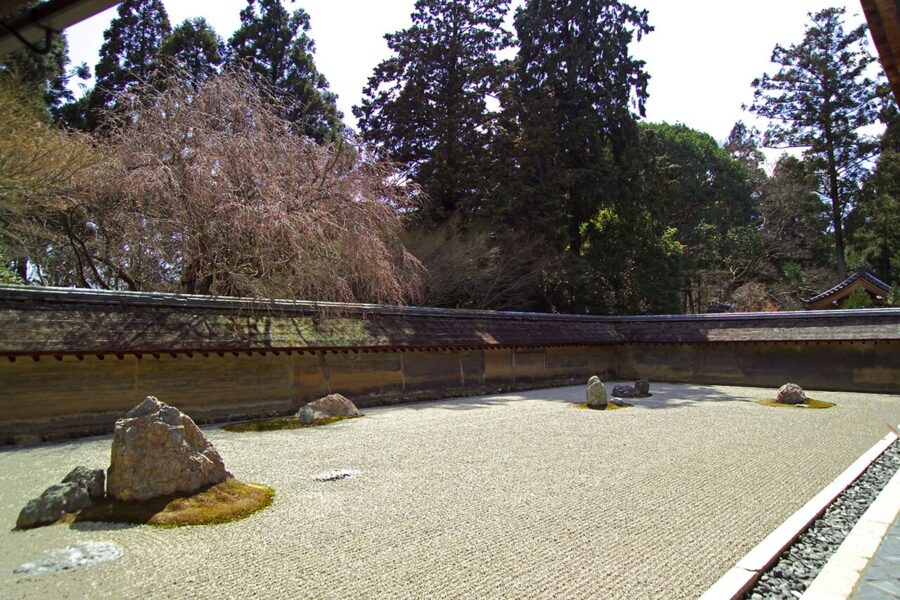
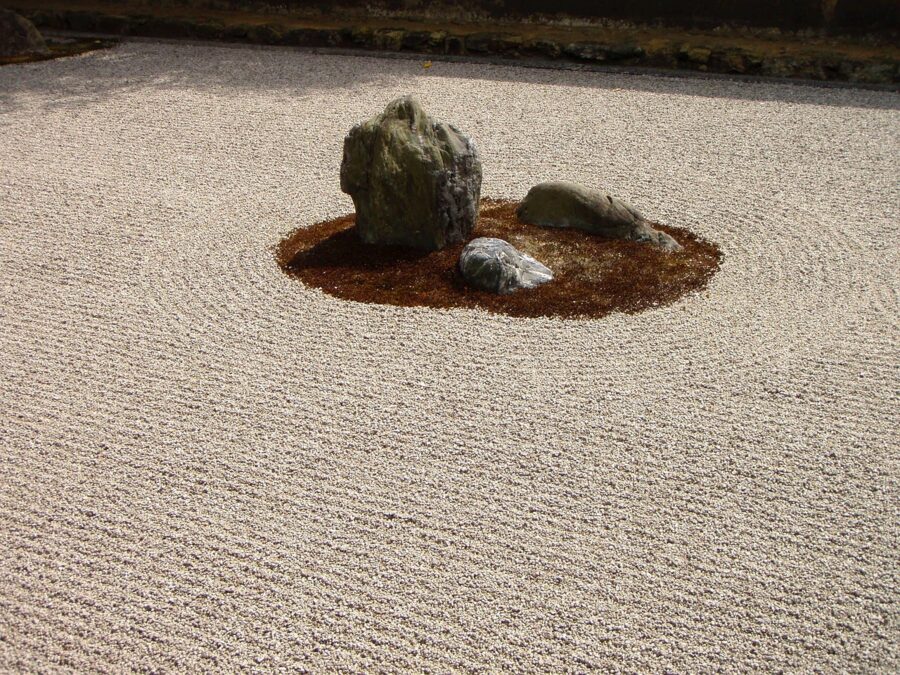
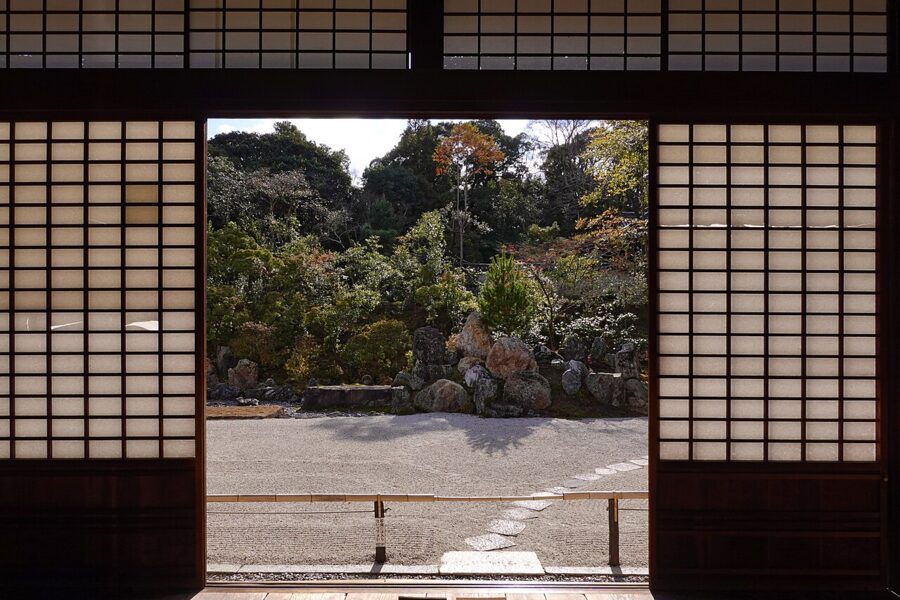
Ryoan-ji’s rock garden in Kyoto holds fifteen stones, and from the temple veranda you can only ever count fourteen. Move a few cushions along and a different stone slips behind its neighbor. Nobody knows for certain who laid the garden out, or when, but whoever did was arranging what you see from where you sit.
Key facts Adult entry (November 2026)
- Kenrokuen, Kanazawa
- ¥320
- Korakuen, Okayama
- ¥500
- Kairakuen, Mito
- ¥320; ¥500 in plum festival
- Ryoan-ji, Kyoto
- ¥600
- Tenryu-ji, Kyoto
- ¥500; ¥800 with halls
- Ginkaku-ji, Kyoto
- ¥1,000
- Saiho-ji, Kyoto
- ¥4,000 or more, plus ¥165
- Katsura Imperial Villa
- ¥1,000 (18 and over)
That is the first thing to know about a Japanese garden. Most are not scenery that happens to be pretty; they are compositions, made to be seen from a set point or along a set path, with every stone and pine placed to do a job. Once you know the jobs, a garden stops being merely calm and starts saying things.

The word on the ticket is 庭園 (teien, garden). The words below it, and the gardens a first trip can actually reach, are what follows.

How to read a garden in five minutes
Japan’s oldest garden manual, the eleventh-century Sakuteiki, tells the builder to follow “the request of the stone”: see which way each rock wants to sit, and set it that way. That is still the best way in for a visitor. Start with the stones, then the water, the plants and the path, and finally whatever lies beyond the wall.
Stones
Stones are the bones of the garden, set in groups called 石組 (ishigumi, stone arrangements). A tall upright stone flanked by two lower ones often stands for a Buddhist trinity or a peak with foothills. A group with a long “neck” stone may be a crane, a squat rounded one a tortoise; both mean long life, and you will find the pair on islands in pond after pond.
Another theme is Horai, the island of the immortals from Chinese legend. Kenrokuen’s first builder set three such islands in its oldest pond, and many smaller gardens have a single rugged rock rising from water or gravel for the same reason.
Water, real or implied
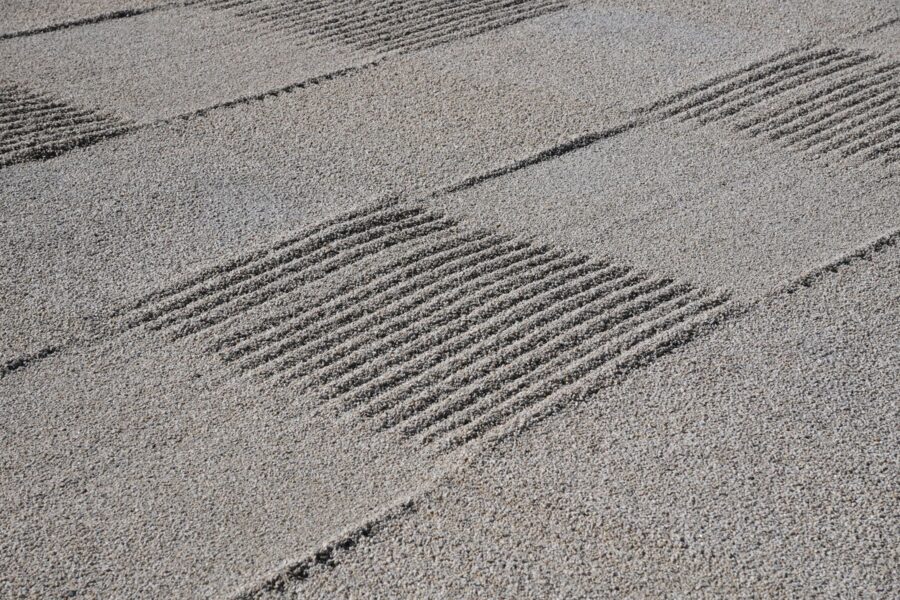
Water is half of 山水 (sansui, mountains and water), the old word for scenery in painting and gardens. In a pond garden it is real: an irregular shore, a stream winding in, a waterfall at the back. In a dry garden, gravel stands in for it, raked straight for calm water and into ripples around the stones.
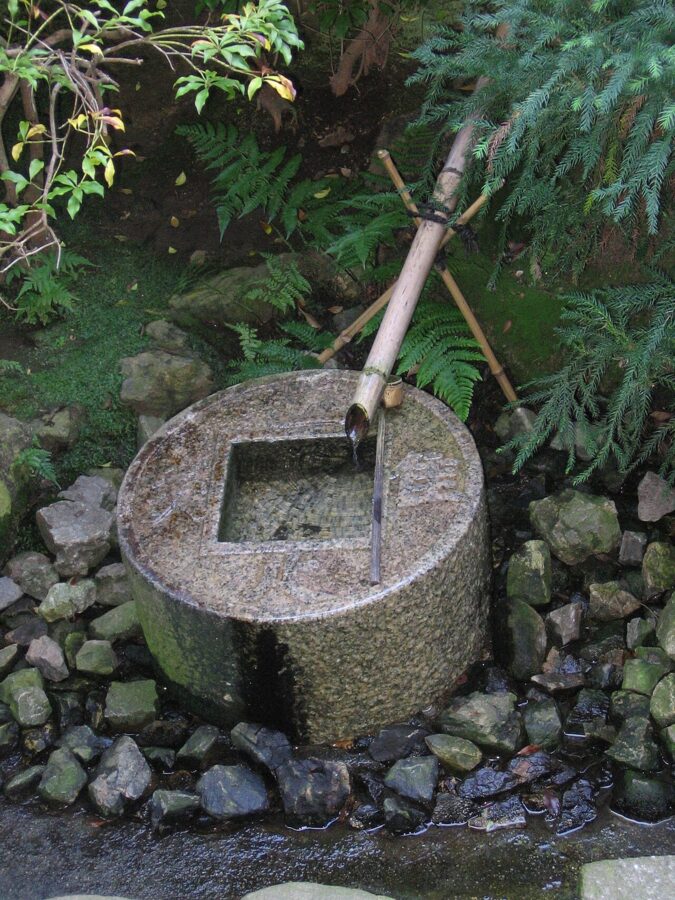
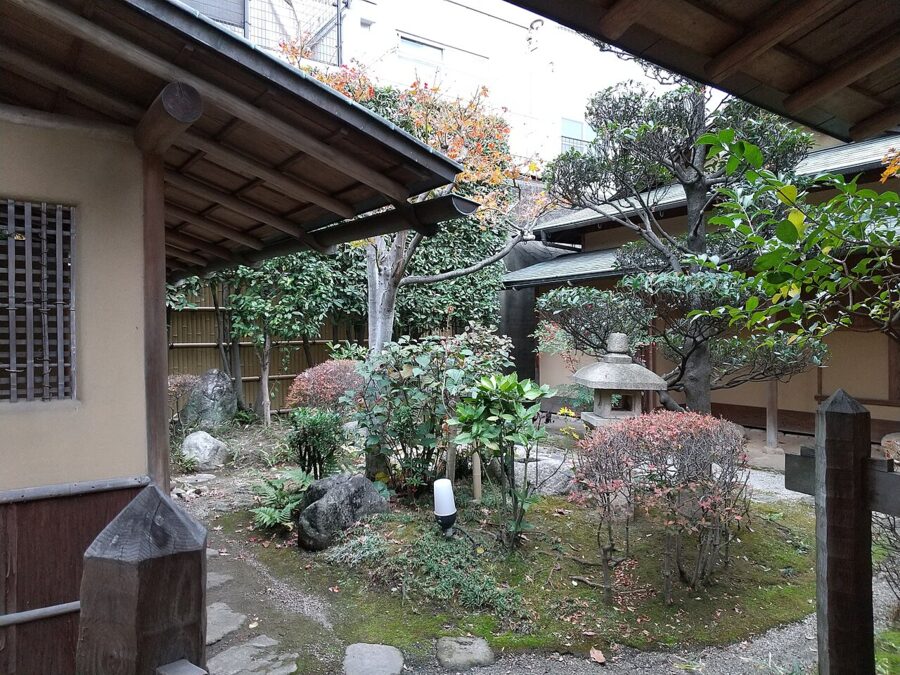
The small stone basin by a path or teahouse is a 蹲踞 (tsukubai), literally “crouching,” because it sits so low you must bend to use it. It is for rinsing your hands before tea, and the crouch is the point: everyone, whatever their rank, gets down to the same height.
Moss, pines and pruning
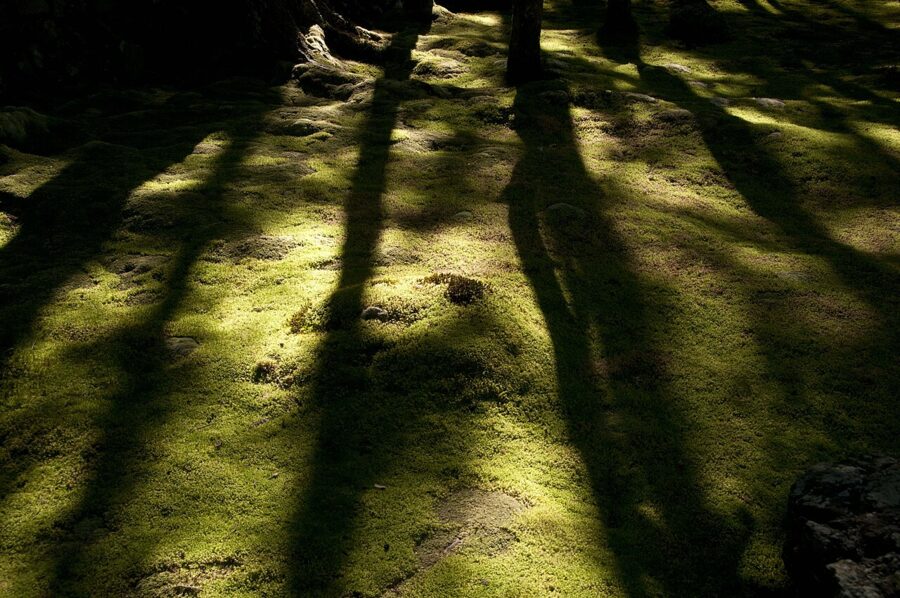
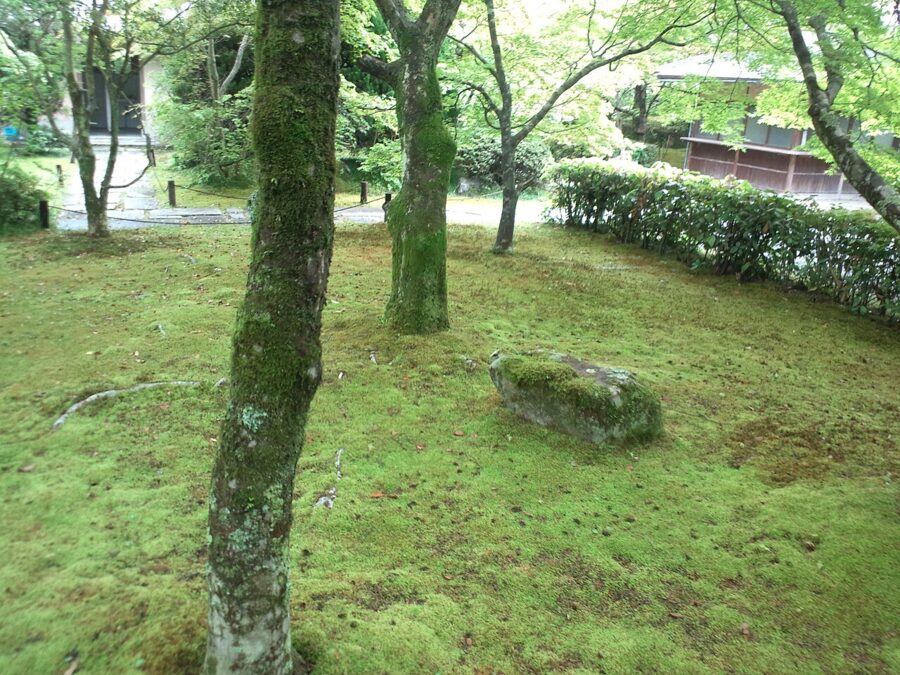
Moss is grown, not tolerated: temples weed it, sweep it and water it in dry spells. It is also fragile, which is why the most famous moss garden limits numbers. Pines are thinned by hand every year so light falls through them, and azaleas are clipped into rounded mounds, 大刈込 (ōkarikomi, large clipped masses), that stand for hills or waves. A tree that looks naturally windswept has usually taken decades of work.
Paths, lanterns and the stone with a rope
Stepping stones, 飛石 (tobiishi), slow you down and choose where you look; a big flat one at a turn is where the designer wants you to stop. Stone lanterns, 灯籠 (tōrō), began as votive lights at temples and shrines. In a garden they light a path for evening tea or simply anchor the view.
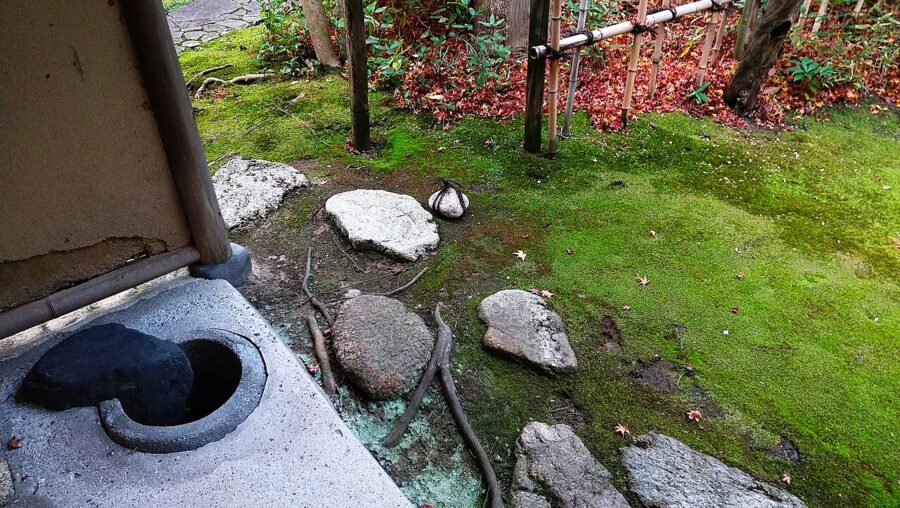

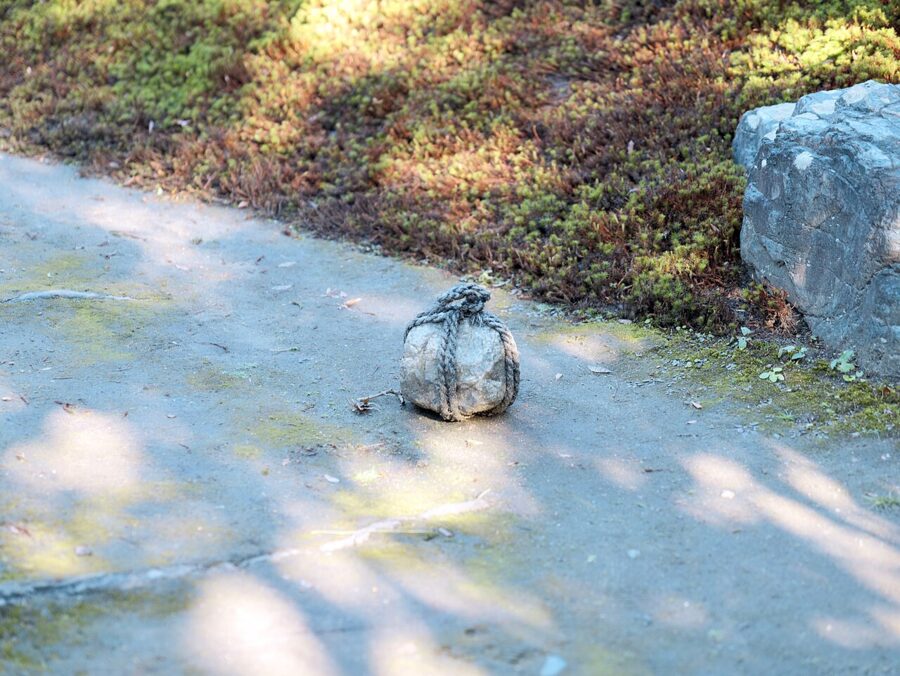
A fist-sized stone tied with black rope, sitting on a path, means “no further.” It is a 関守石 (sekimori-ishi, barrier-guard stone), and it is a rule, not decoration.
Borrowed scenery
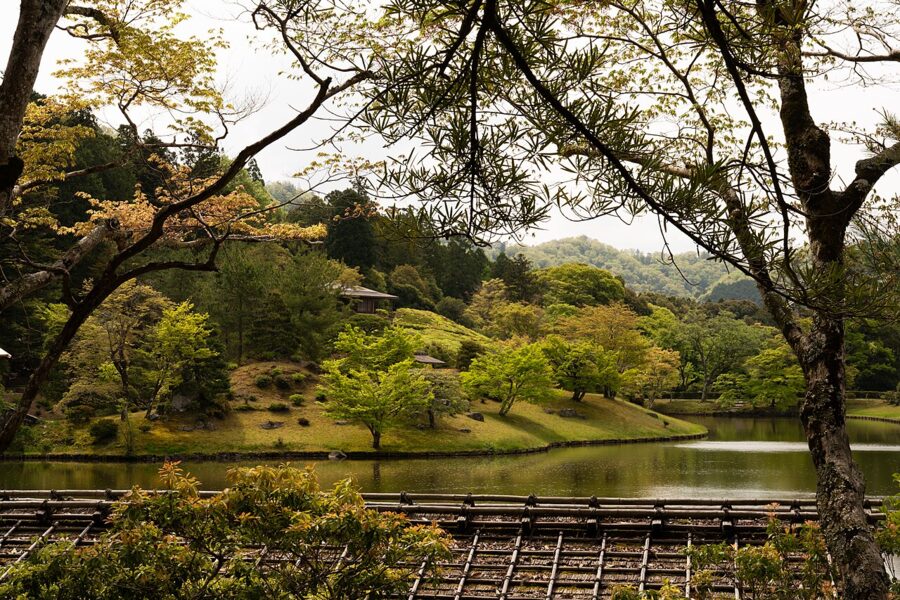
The quietest trick is 借景 (shakkei, borrowed scenery): building a garden so that a mountain, forest or castle outside it becomes part of the view. The back hedge is clipped just high enough to hide the roads and fields between, and the distant hill seems to sit at the garden’s edge.

Ten words cover most signboards:
- 庭園 (teien): garden, the formal word on maps and tickets.
- 池泉回遊式 (chisen kaiyūshiki): pond-and-stroll, a garden to walk around.
- 枯山水 (karesansui): dry garden of stone and gravel.
- 露地 (roji): tea garden; literally “dewy ground.”
- 坪庭 (tsuboniwa): small garden enclosed by buildings.
- 築山 (tsukiyama): artificial hill of earth and stone.
- 借景 (shakkei): borrowed scenery beyond the wall.
- 石組 (ishigumi): a deliberate arrangement of stones.
- 雪吊り (yukitsuri): ropes that hold up branches under snow.
- 特別名勝 (tokubetsu meishō): Special Place of Scenic Beauty, the top national designation.
The four kinds you will meet
Garden histories list a dozen styles, but on the ground you will meet four, often mixed. Saiho-ji has a pond garden below and a dry stone cascade above, and big estate gardens usually hide a tea garden somewhere inside.
Pond and stroll gardens
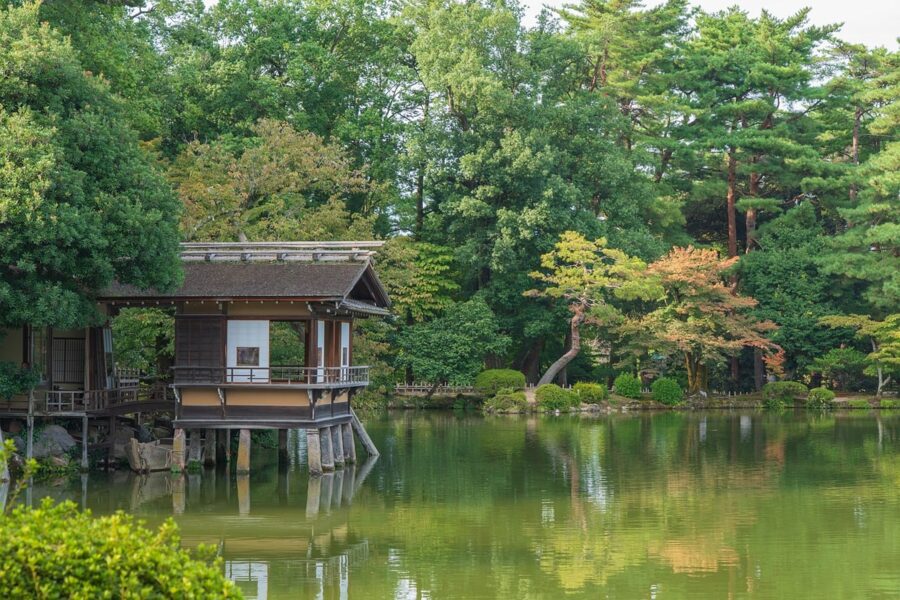
The pond-and-stroll garden is the walking garden. A path circles a large pond past hills, bridges, teahouses and islands, and each bend opens a new view, often a miniature of a famous place in Japan or China. Most big strolling gardens were built by feudal lords in the Edo period (1603 to 1868) and are called 大名庭園 (daimyō teien, lords’ gardens).
Dry gardens
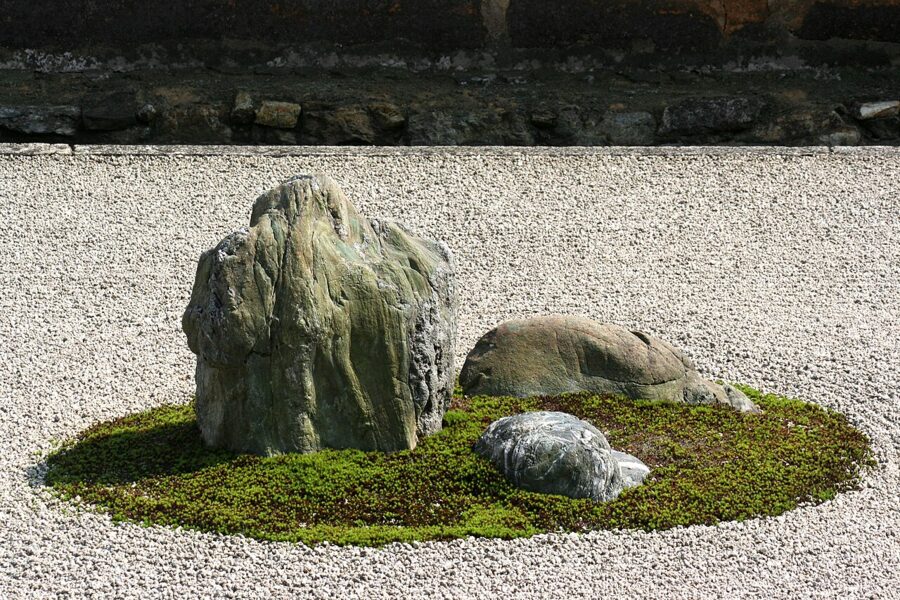
The dry garden uses stone, gravel, moss and a few clipped shrubs to suggest mountains, rivers and sea. Dictionaries trace karesansui to the ink paintings that reached Japan from Song and Ming China. Most surviving examples are in Zen temples, laid out to be viewed from a hall, never walked into.
One correction: “Zen garden” is mostly an English label. Signs in Japan say 枯山水 or 石庭 (sekitei, stone garden), and the gardens were made to be looked at, not as aids to meditation.
Tea gardens
The roji is the path to a teahouse, built to leave the world outside. Expect a waiting bench, stepping stones, a low basin, a lantern and plain evergreen planting with few showy flowers. The sixteenth-century tea master Sen no Rikyu set much of the pattern tea gardens still follow.

Courtyard gardens
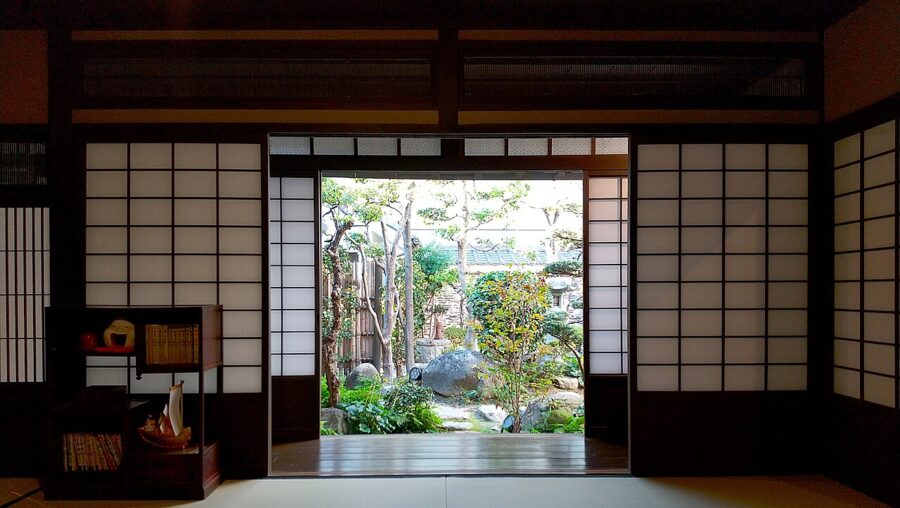
A tsuboniwa is a garden a few steps across, wedged between the rooms of a townhouse or inn to bring in light and air. A lantern, a basin, bamboo and moss are typical. You will find them in old merchant houses, inns and restaurants, best seen from the tatami room through open doors.

Who made them
Most gardens carry no signature. Two names matter for a visitor, because you can still stand in their work.
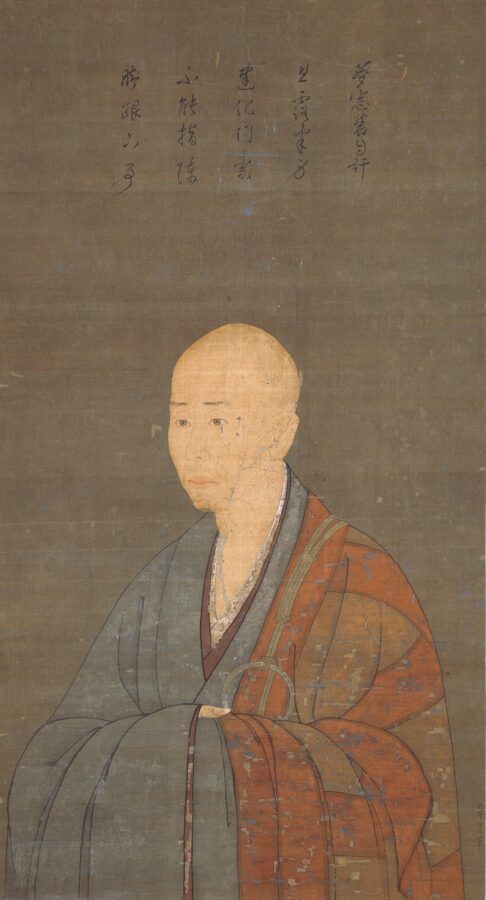
Muso Soseki (1275 to 1351), a Zen priest, poet and adviser to the Ashikaga shoguns, reshaped Saiho-ji and laid out the pond garden at Tenryu-ji. Both join a strolling pond below to dry stonework on the slope above, the two traditions that followed.
Kobori Enshu (1579 to 1647), a lord, tea master and official in charge of building works, is the name you will hear too often. Guides credit him with half of Kyoto, Katsura Imperial Villa included, though no record shows he worked there. His documented work includes the crane-and-tortoise garden at Konchi-in, beside Nanzen-ji, so read “attributed to Kobori Enshu” on a sign as exactly that.

The Three Great Gardens
Kenrokuen in Kanazawa, Korakuen in Okayama and Kairakuen in Mito are the 日本三名園 (Nihon sanmeien, Japan’s three famous gardens). They were never a set: three lords built them between 1676 and 1842, for different reasons. What they share is scale, a strolling layout and a long habit of letting the public in.
Kenrokuen, Kanazawa
Maeda Tsunanori, fifth lord of Kaga, began the garden in 1676 below Kanazawa Castle, and his successors kept adding. Its name, given in 1822, answers a Song dynasty book which held that no garden could combine six qualities: spaciousness and seclusion, artifice and age, water and long views. Kenrokuen, “the garden combining six,” claims all of them.
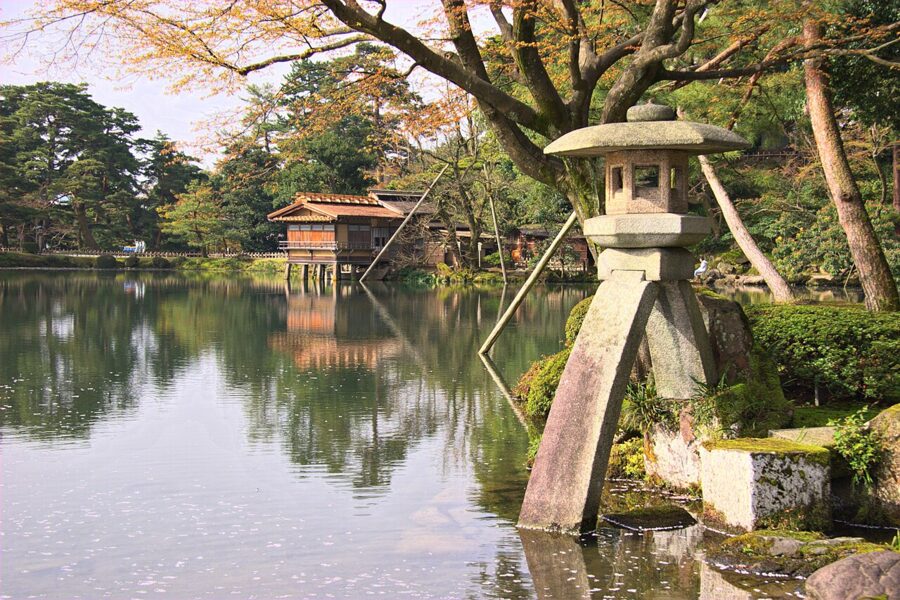

Entry to Kenrokuen is ¥320 (about US$2) for adults 18 and over as of November 2026, and free from age 65 with ID. It opens 7 a.m. to 6 p.m. from March 1 to October 15, otherwise 8 a.m. to 5 p.m., and two gates admit people free in the early morning before paid hours. The bus from Kanazawa Station to Kenrokuen-shita takes about 12 minutes.
Korakuen, Okayama
Lord Ikeda Tsunamasa had his retainer Tsuda Nagatada begin the garden in 1687, and it was largely finished by 1700. It is the brightest of the three: open lawns, a stream about 640 meters (700 yards) long, tea pavilions and a patch of paddy, a reminder that a lord was meant to care about farming.
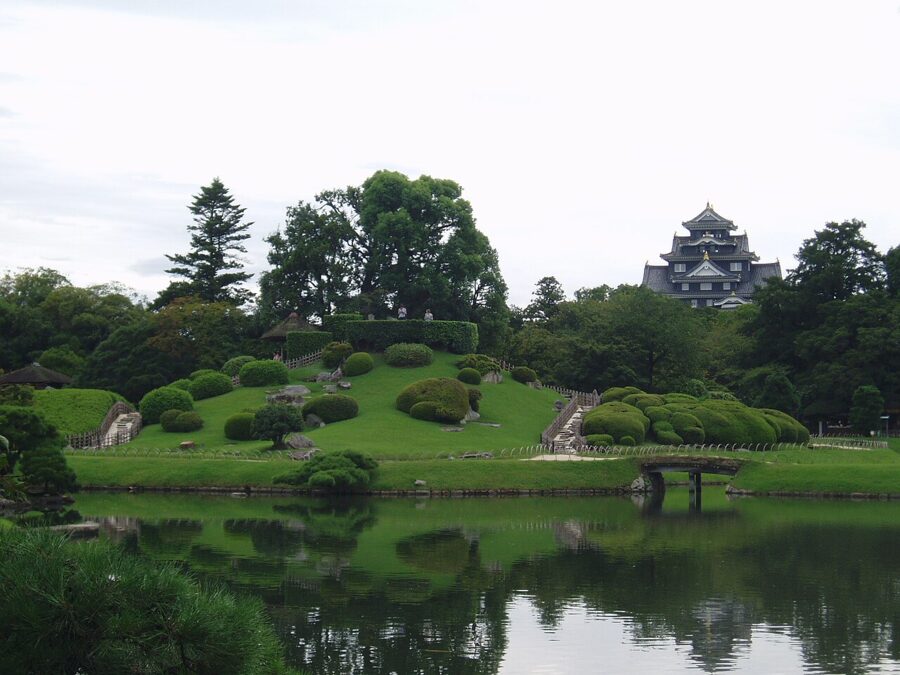

Adults pay ¥500 (about US$3) as of November 2026, seniors ¥200, and high school students and younger enter free until March 31, 2027. Hours are 7:30 a.m. to 6 p.m. from March 20 to September 30, otherwise 8 a.m. to 5 p.m. It is about 25 minutes’ walk from JR Okayama Station.
Kairakuen, Mito
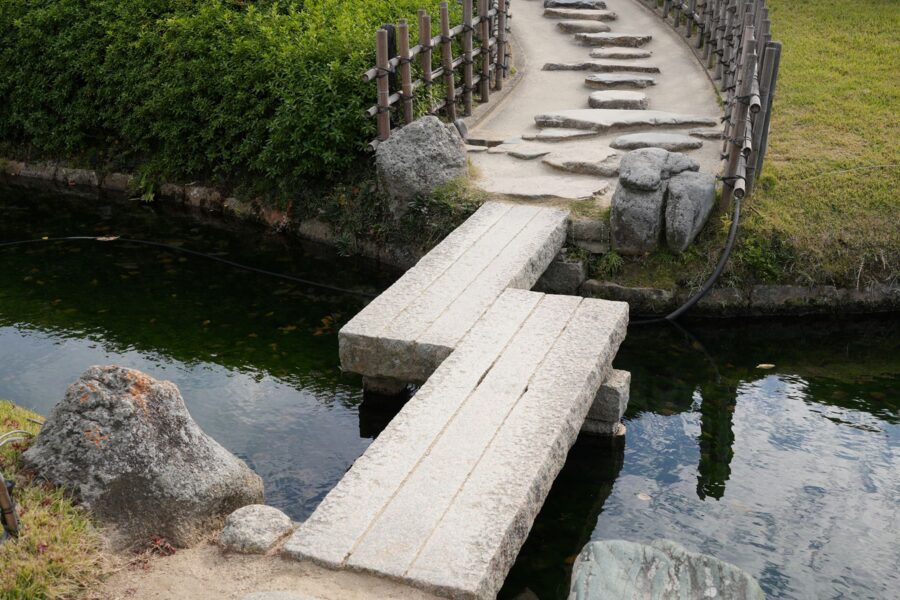
Tokugawa Nariaki, lord of Mito, opened Kairakuen in 1842 as the partner of his domain school: study there, rest here. The name comes from Mencius, on rulers who enjoy things together with their people, and the garden was open to townspeople from the start.
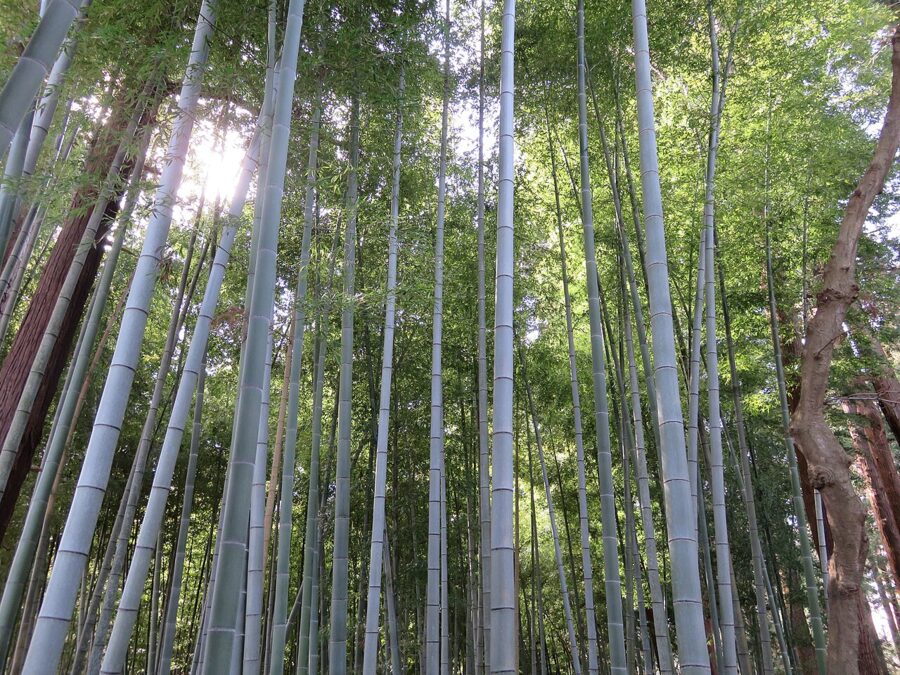

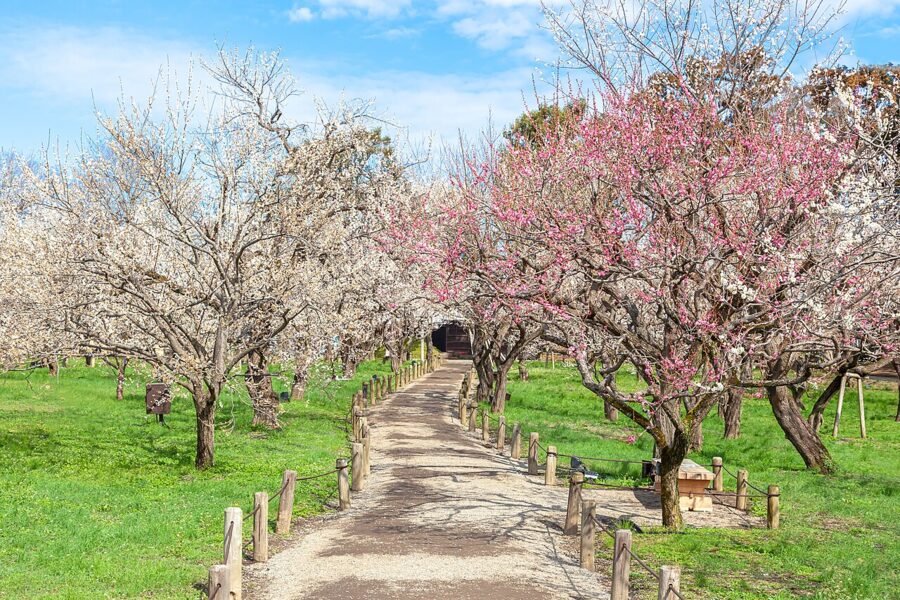
Kairakuen is the plum garden, with about 3,000 trees of some 100 varieties. Outside the Mito Plum Festival (mid-February to late March), adults pay ¥320 and entry is free until 9 a.m.; during the festival it costs ¥500, a new festival rate announced in October 2026. The main garden opens at 6 a.m. from mid-February to September and at 7 a.m. otherwise, and buses from JR Mito Station’s north exit take about 20 minutes.

Kyoto: the gardens worth the queue
Kyoto has more great gardens than any trip can hold. These six are the ones I would plan around, two of them only with paperwork; prices are as of November 2026.
Ryoan-ji
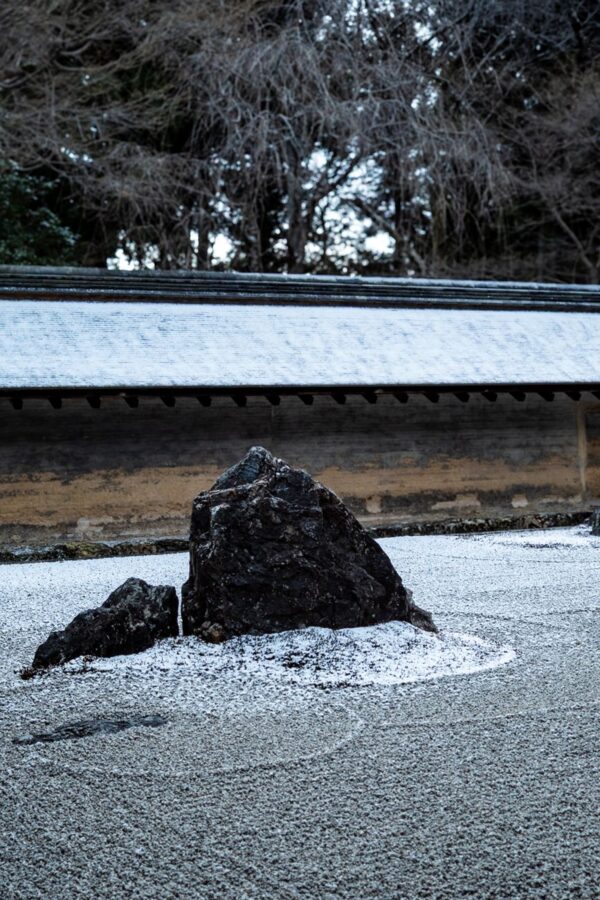
The rock garden is small, a walled rectangle of gravel about the size of a tennis court. Entry is ¥600 (about US$4), and the temple opens 8 a.m. to 5 p.m. from March to November and 8:30 a.m. to 4:30 p.m. in winter. Arrive at opening and give it ten minutes before the tour groups do.
Tenryu-ji
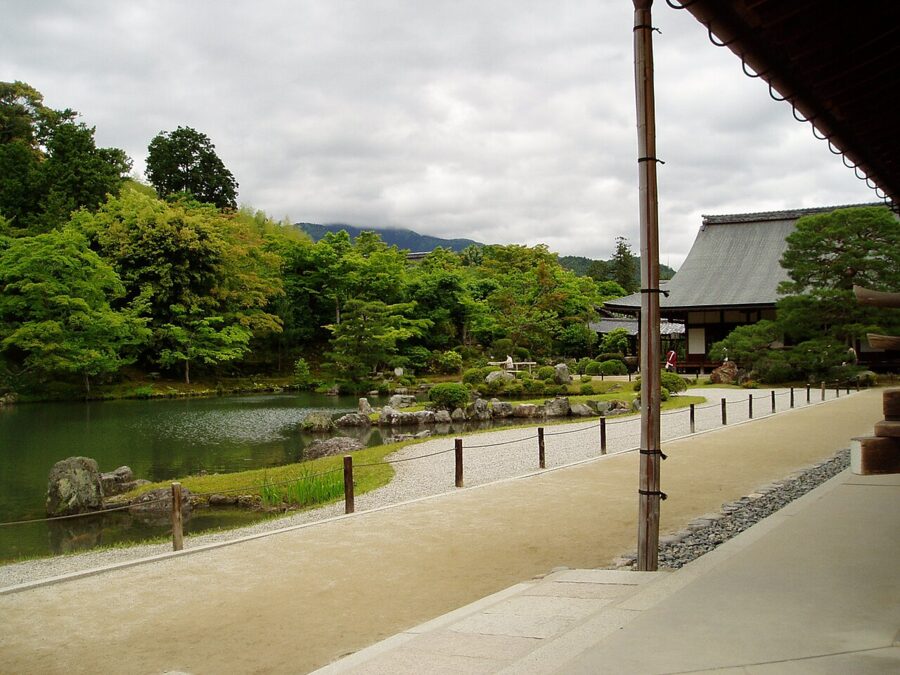
Muso Soseki’s Sogenchi, in Arashiyama, is a pond made to be seen from the hall: a stone waterfall at the back, a curve of white sand in front and the wooded hills borrowed behind. The garden ticket is ¥500, plus ¥300 for the halls, from 8:30 a.m. to 5 p.m. From November 14 to 30, 2026, it also opened at 7:30 a.m. for the autumn leaves.

Ginkaku-ji
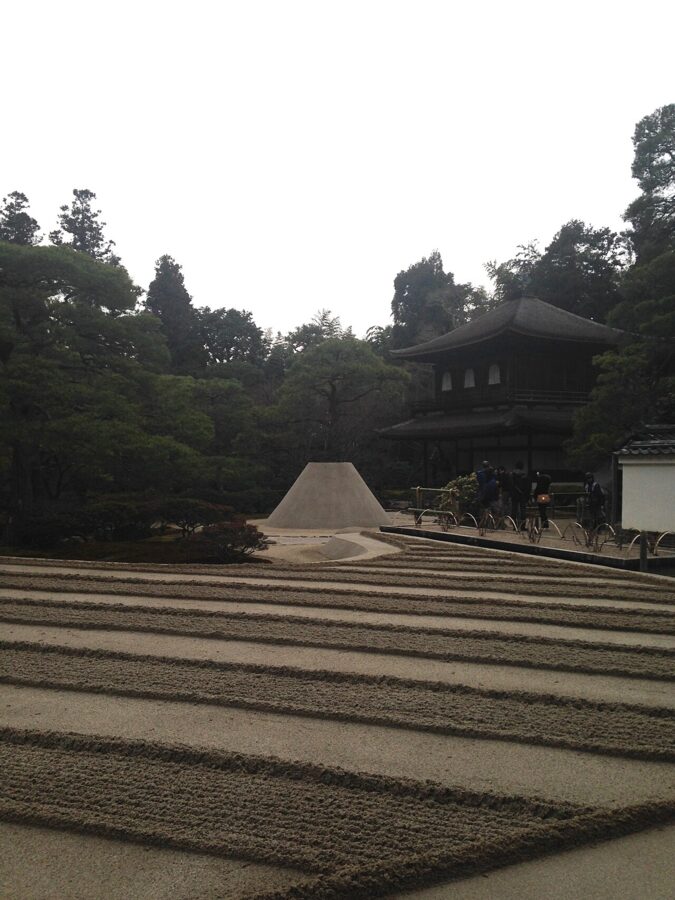
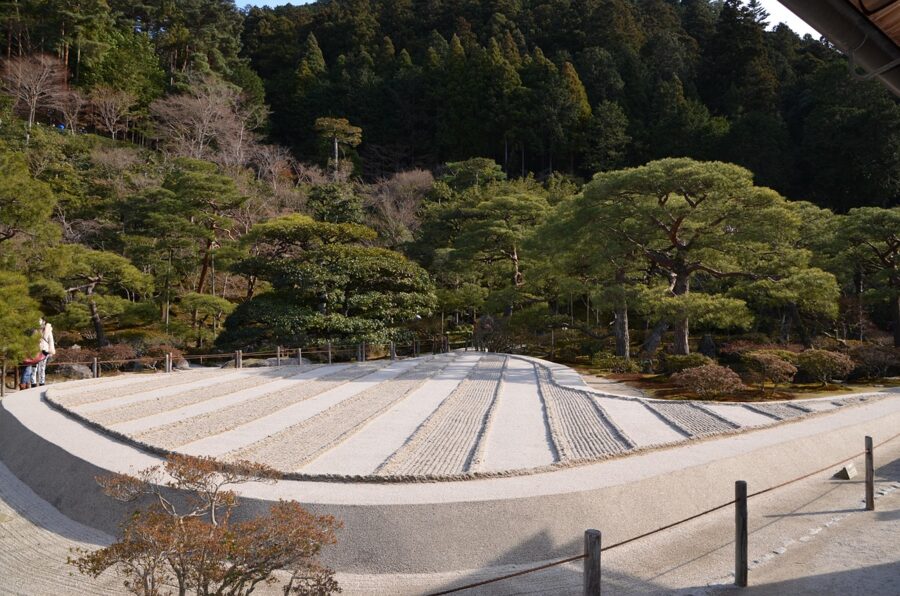
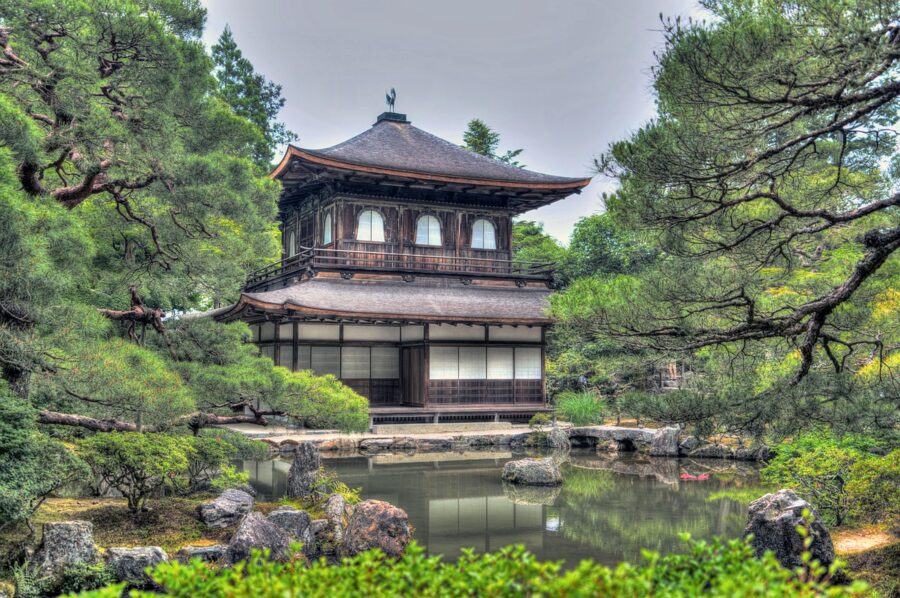
The Silver Pavilion was never silvered; its gardens are the draw. Before the hall lies a raked sand bed, 銀沙灘 (ginshadan, silver sand sea), beside a flat-topped sand cone, 向月台 (kōgetsudai, moon-viewing platform), and behind them a moss and pond garden climbs to a lookout. The temple doubled its fee on April 1, 2026: adults now pay ¥1,000 (about US$7).

Saiho-ji, the moss temple
Saiho-ji has admitted only small, pre-booked numbers since 1977. You apply online or by return postcard. Online slots open two months ahead and close at 11:59 p.m. the day before, for up to two people; the offering is ¥4,000 or more (about US$26) each, by card, plus a ¥165 system fee.
Visitors must be 13 or older, and the visit begins with copying a sutra in the main hall, about an hour in all. The temple’s booking rules charge half the fee for cancelling from three days before, and all of it on the day. Regular visits pause from January 12 to February 26, 2027.

Katsura and Shugakuin, by permit
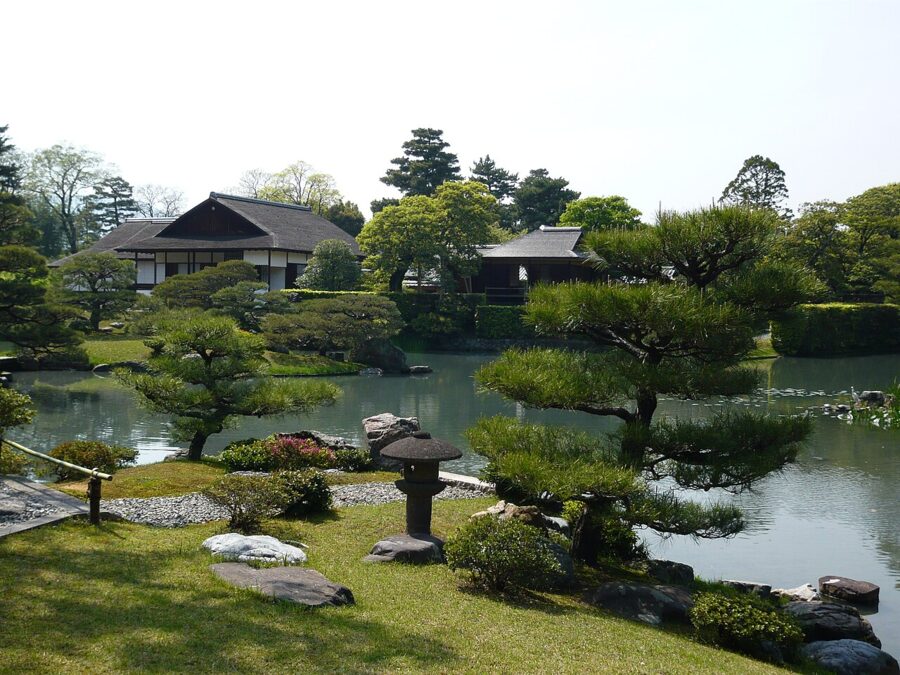
Two imperial villas, run by the Imperial Household Agency, are seen only on guided tours of the grounds. Katsura, begun by princes of the Hachijo family in the early seventeenth century, is often called the finest stroll garden in Japan. Shugakuin, retired Emperor Go-Mizunoo’s hillside estate from the 1650s, is three gardens joined by paths through working rice fields.

Apply on the agency’s visit booking site. Online booking opens at 5 a.m. Japan time on the first day of the month three months ahead and closes three days before; up to four people per application, all named. Everyone shows ID on the day, so carry your passport.
- Katsura: ¥1,000 from age 18; middle-school age and up only; about an hour over 1 kilometer (0.6 miles) of uneven path. English tours start at 9:20 and 11:20 a.m. and 1:20, 3:20 and 4:20 p.m. (no 4:20 from October to February). Some 70 same-day places on Japanese tours go out at the gate from 8:40 a.m., with free English audio guides. Closed Mondays; 20 minutes’ walk from Hankyu Katsura Station (Katsura rules, as of November 2026).
- Shugakuin: free, 18 and over only. About 80 minutes over 3 kilometers (2 miles) with steep slopes, at 9, 10 and 11 a.m., 1:30 and 3 p.m.; 50 same-day places from 8:40 a.m. Closed Mondays; 20 minutes’ walk from Shugakuin Station on the Eizan line (Shugakuin rules).
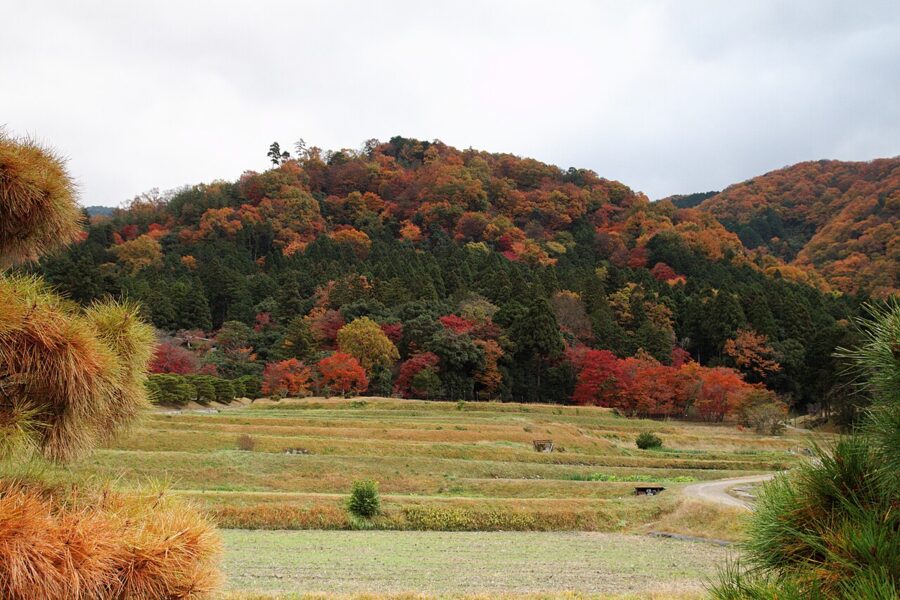

Tokyo’s gardens between the towers
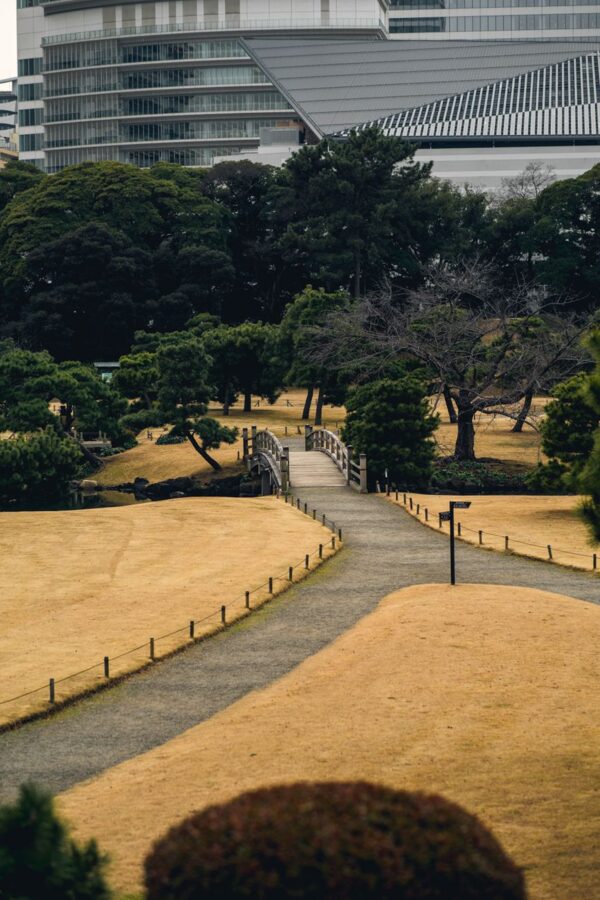
Tokyo’s best gardens are lords’ estates now run by the city. Rikugien, Koishikawa Korakuen and Hamarikyu each charge ¥300 (about US$2), ¥150 from age 65, as of November 2026. All open 9 a.m. to 5 p.m. (last entry 4:30), close December 29 to January 1 and admit no pets.
Rikugien
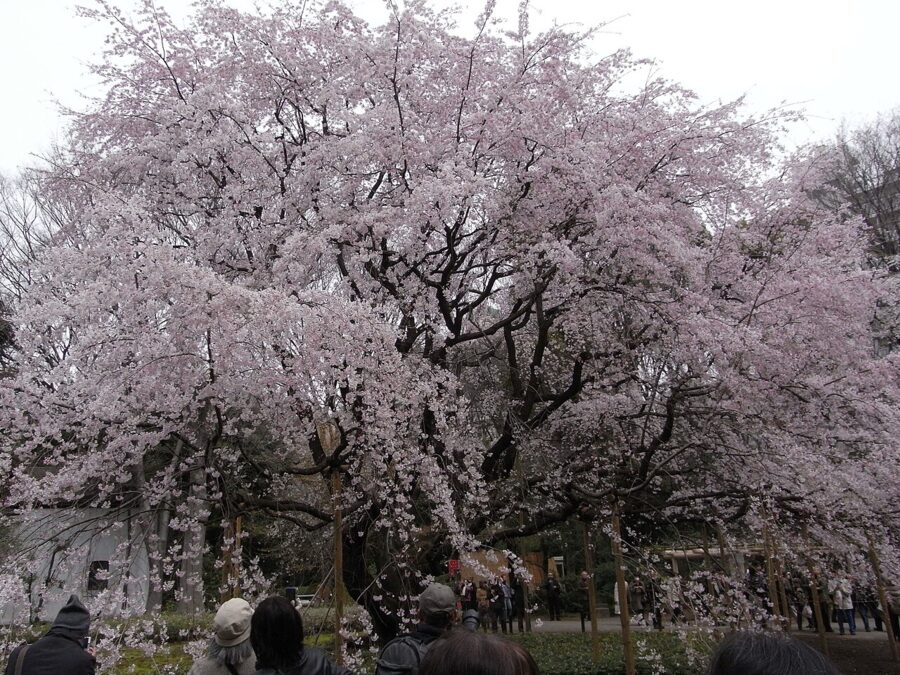
Yanagisawa Yoshiyasu, the shogun’s favorite, built Rikugien over seven years from 1695, naming its 88 views after classical waka poetry. The giant weeping cherry by the inner gate draws crowds in late March, and in 2026 the garden held autumn night openings from November 25 to December 6. Komagome Station is seven minutes’ walk.
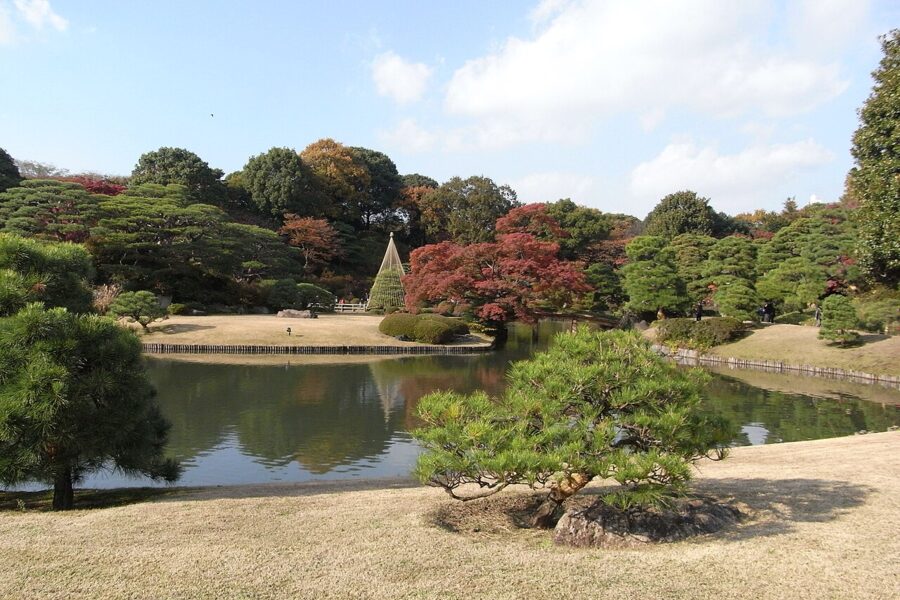

Koishikawa Korakuen
Begun in 1629 by Tokugawa Yorifusa, lord of Mito, and finished by his son Mitsukuni, this is Tokyo’s oldest surviving lord’s garden. The Chinese scholar Zhu Shunshui suggested its name and, it is said, designed its stone Engetsukyo bridge. It is three minutes from Iidabashi Station on the Oedo line.
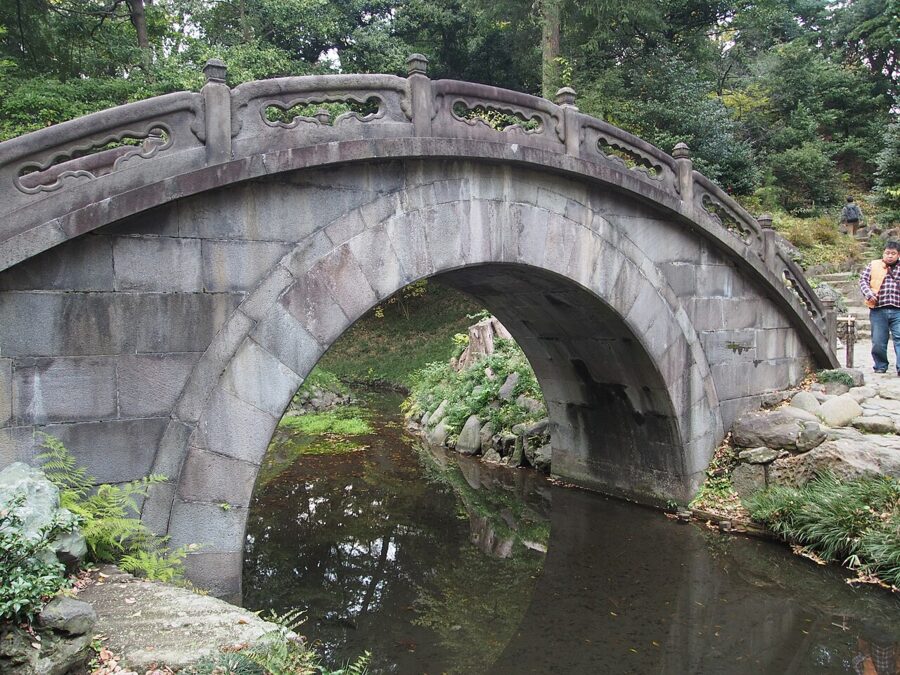

Hamarikyu
Below the Shiodome towers, Hamarikyu was a shogun’s seaside villa and duck-hunting ground. Tokyo’s gardens once had many tidal ponds, and this is the only one where the sea still flows in and out. The Nakajima teahouse on the pond, rebuilt in 1983, serves matcha with a sweet, a pairing from the traditional foods of the tea ceremony.
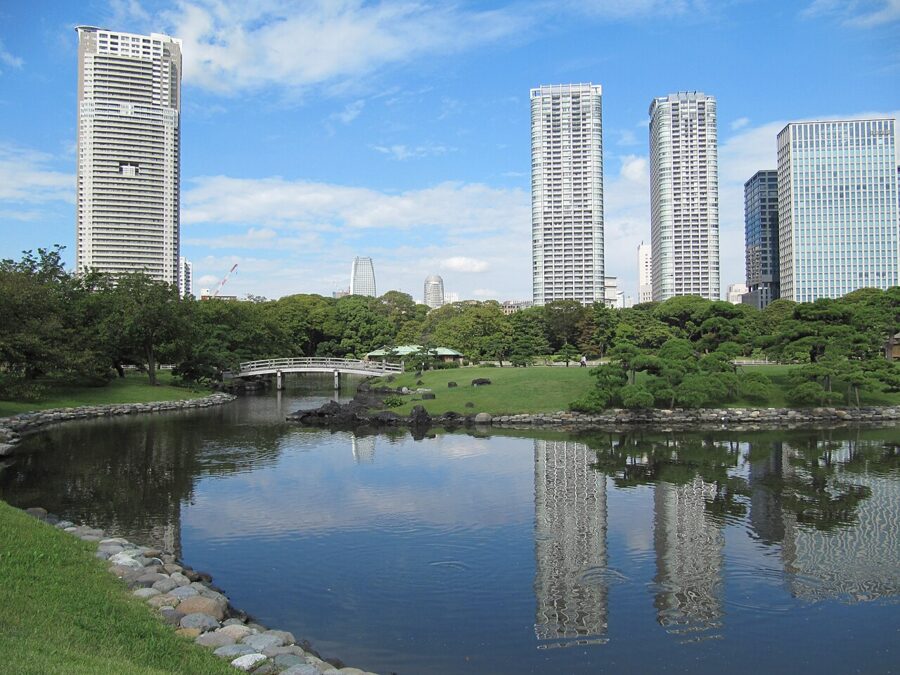
A garden year
Gardens are planted for the calendar. For weather and holiday crowds, see the best times to visit Japan; here is how the year plays out in the gardens.
- Plum, February to March. The year’s first flowers, best at Kairakuen, and far quieter than cherry season.
- Cherry, late March to early April. Weeping cherries at Rikugien and in Kyoto temples; Kenrokuen opens free for about a week at peak.
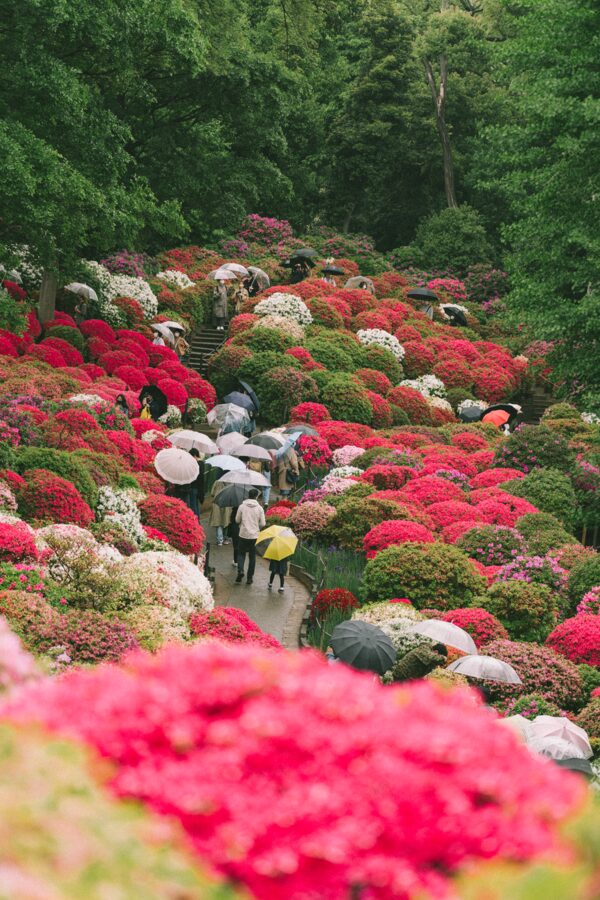
- Azalea, late April and May. Clipped mounds flower pink and red, and new maple leaves are at their brightest.
- Iris, June. Rainy season brings irises to wet beds, and the moss at its deepest green.
- Autumn color, mid-November to early December. Light-ups, early openings and the year’s heaviest crowds.
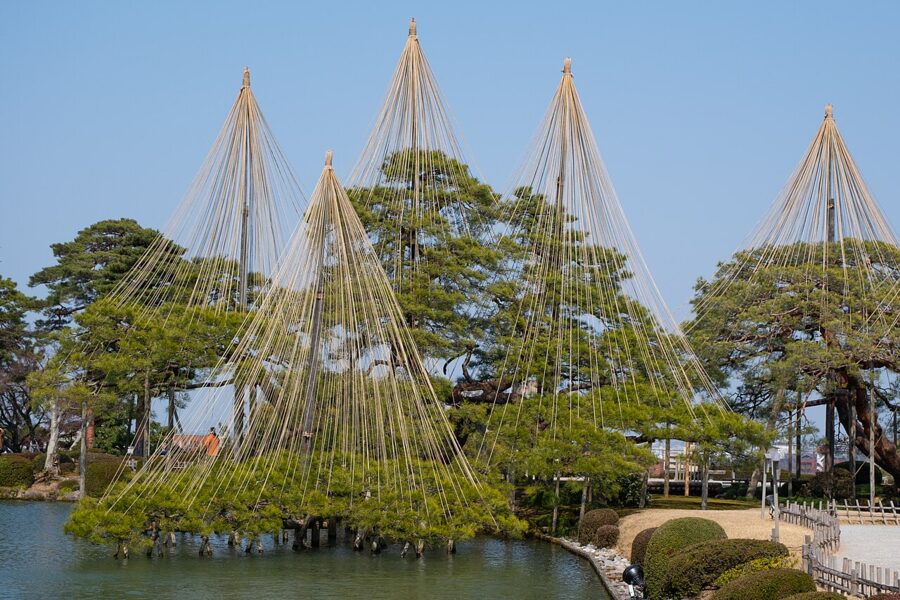
- Snow, January and February. Fewer people, gravel under snow and yukitsuri ropes over the pines.

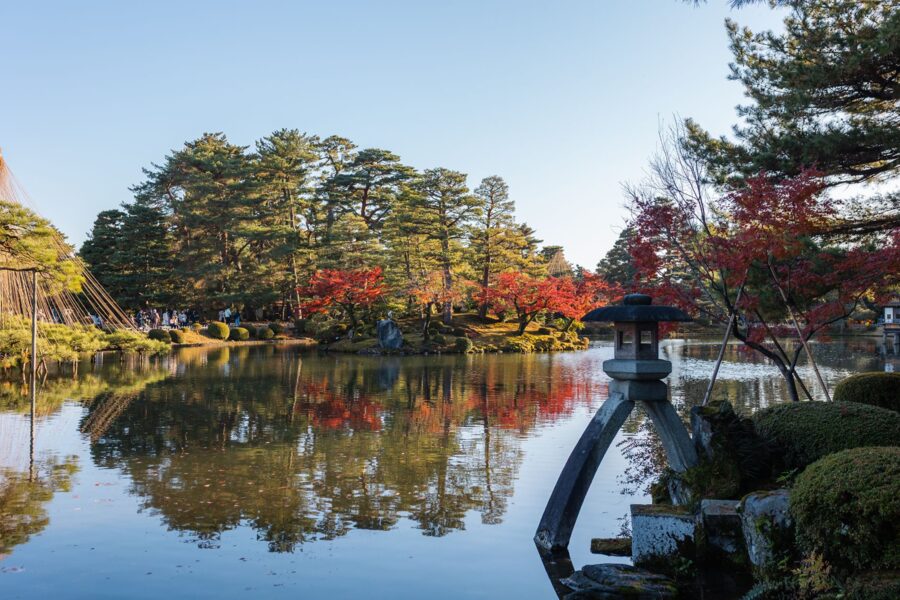
Yukitsuri is Kanazawa’s winter signature. From early November, Kenrokuen’s gardeners raise a pole by each prized pine and run ropes from its tip to the branches, so the heavy, wet snow of the Japan Sea coast cannot snap them. The great Karasaki pine is traditionally done first.

Manners, tickets and timing
Everything in front of you is maintained by hand, often daily. Stay on the paths, never step on moss or raked gravel, and leave the stones alone. A rope stone or a low bamboo rail means the same as a locked gate.

At temples you take your shoes off to sit on the veranda facing the garden, so wear socks without holes and shoes that slip off easily. In a rented kimono, stepping stones and gravel are the hard part; keep to the main path. Photography from public areas is generally fine, though gardens such as Kairakuen want notice of commercial shoots.
Tour buses arrive mid-morning and leave mid-afternoon, so come at opening or in the last hour. Kenrokuen’s free early entry and Kairakuen’s free hour before 9 a.m. are worth a dawn alarm. The big gardens take cards and transit IC cards, but carry some yen in cash for smaller temples.
| Garden | Adult entry (November 2026) | Booking |
|---|---|---|
| Kenrokuen, Kanazawa | ¥320 | None |
| Korakuen, Okayama | ¥500 | None |
| Kairakuen, Mito | ¥320; ¥500 in plum festival | None |
| Ryoan-ji, Kyoto | ¥600 | None |
| Tenryu-ji, Kyoto | ¥500; ¥800 with halls | None |
| Ginkaku-ji, Kyoto | ¥1,000 | None |
| Saiho-ji, Kyoto | ¥4,000 or more, plus ¥165 | Required |
| Katsura Imperial Villa | ¥1,000 (18 and over) | Permit |
| Shugakuin Imperial Villa | Free (18 and over only) | Permit |
| Rikugien, Koishikawa Korakuen, Hamarikyu | ¥300 each | None |
Japan has 36 Special Places of Scenic Beauty as of November 1, 2026, and nine of the gardens above are among them. If you have time for only one, give it a whole morning. Sit, find the stones, follow the water, look past the wall, and somewhere at Ryoan-ji the fifteenth stone is still hiding behind the fourteenth.