
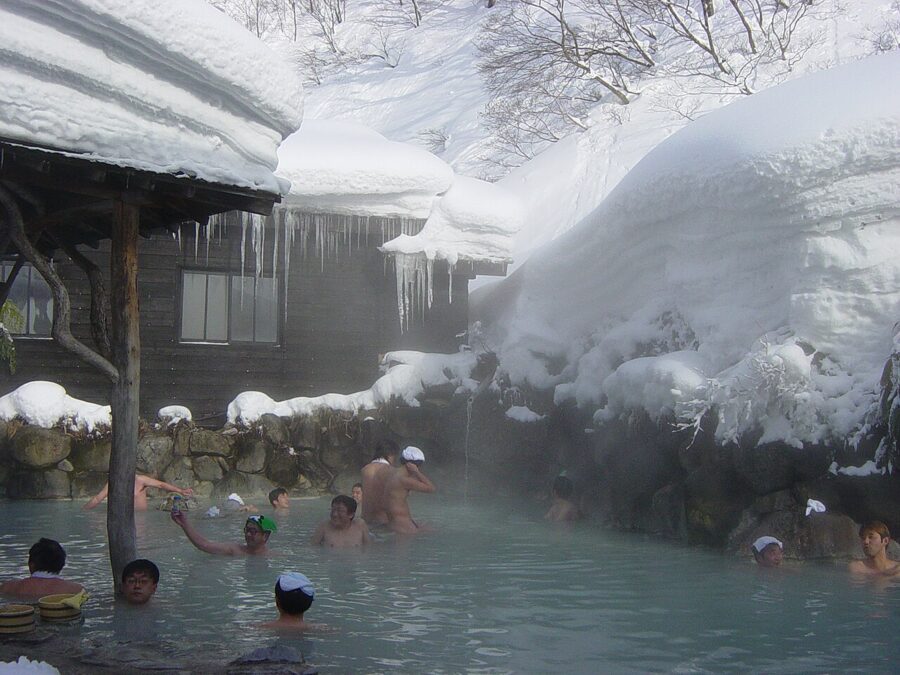

Japan’s official register lists 27,899 hot spring sources, and every bath fed by them runs on the same first rule: you wash before you get in. Not a rinse on the way past. A proper scrub, sitting down, with soap, so that the water everyone shares stays clean.
Key facts Japanese
- Simple spring
- 単純温泉
- Chloride (salt) spring
- 塩化物泉
- Hydrogen carbonate spring
- 炭酸水素塩泉
- Sulfate spring
- 硫酸塩泉
- Carbon dioxide spring
- 二酸化炭素泉
- Iron spring
- 含鉄泉
- Acidic spring
- 酸性泉
- Iodine spring
- 含よう素泉
Everything else follows from that rule. You bathe naked because a swimsuit carries in whatever it touched last; the small towel stays out of the water for the same reason. See the bath as a shared pot of clean hot water and the etiquette starts to look like common sense.

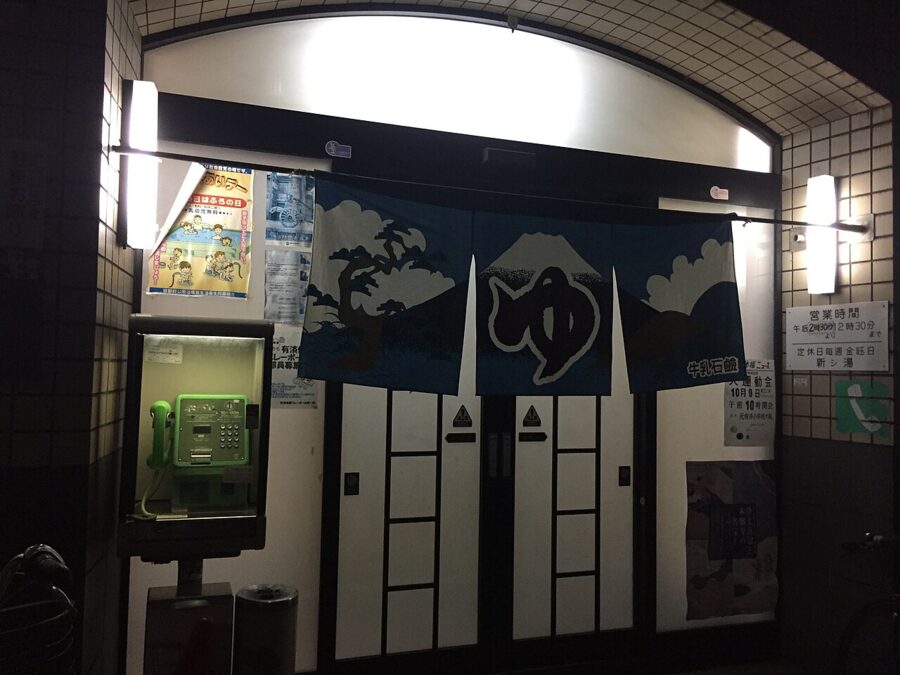
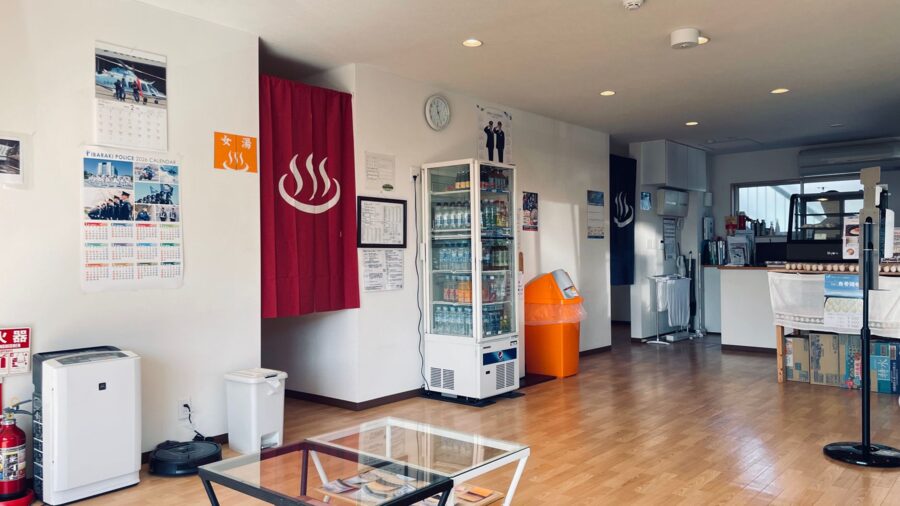
The word itself is 温泉 (onsen), “warm spring”. The sign to learn first, though, is a single hiragana character on a curtain.

What makes water an onsen
An onsen is defined in law. The Hot Springs Act of 1948 counts as a hot spring any water, steam or gas that comes out of the ground at 25°C (77°F) or warmer at the source, or that carries any one of 19 listed substances above a set amount. The list runs from dissolved minerals (1,000 milligrams per kilogram of water) to iron, sulfur and radon.
That “or” surprises people: a cold spring can still be a legal onsen if it is mineral enough, which is why some baths heat their water. A stricter class, 療養泉 (ryōyōsen, therapeutic spring), needs higher concentrations; those are the ten types further down.

The scale is hard to picture. The ministry’s hot spring figures for fiscal 2024 (to the end of March 2025) count 27,899 sources, 2,839 onsen areas with somewhere to stay, and 7,721 public baths using spring water. Japan has so many because it sits on the same restless plates that cause its earthquakes: volcanoes and the heat deep underground warm groundwater across the country.
One more sign is worth learning before you go: 源泉かけ流し (gensen kakenagashi). It means the bath is fed straight from the source and the overflow runs away rather than being filtered and pumped around again. Baths that add water, heat or recirculate it must say so on a posted notice.
Onsen, sento and super sento
A 銭湯 (sentō) is a neighborhood public bath, usually heated tap or well water in a tiled room, built for people who once had no bath at home. A sento is an onsen only if its water comes from a registered spring, and a few in Tokyo do: Ota Ward’s are known for brown-black 黒湯 (kuroyu) water. A スーパー銭湯 (sūpā sentō, super sento) is a big modern version with several pools, saunas and a restaurant, sometimes on spring water and sometimes not.
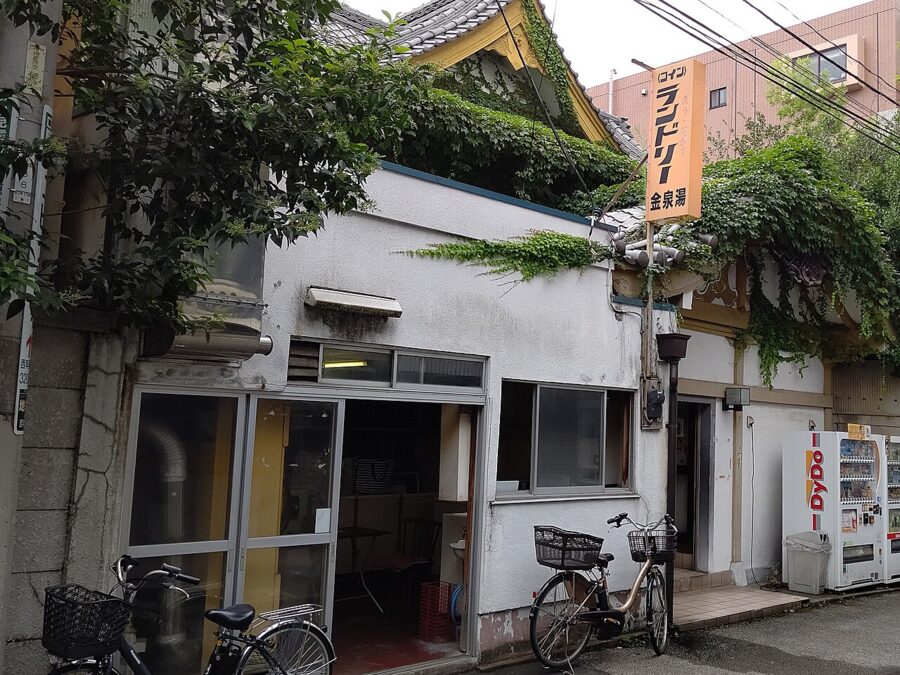

For a first-timer the difference matters little. The routine is the same in all three, and a sento is the cheapest place to practice it.
The hot spring symbol
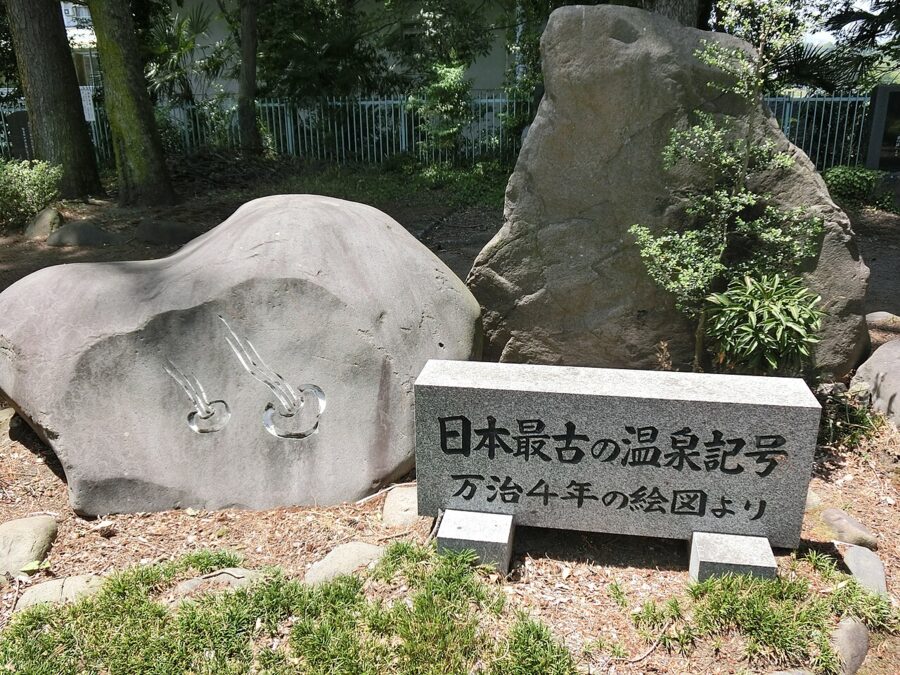
The symbol of three wavy lines rising from a bowl, ♨, marks hot springs on maps, road signs and inn curtains. Isobe Onsen in Gunma claims the oldest known use, on a map dated 1661. In 2017, when Japan’s industrial standards body proposed a new version with three bathing figures for foreign visitors, the old mark had so many defenders that both were kept.
Reading the entrance
Most baths split by sex, and the split is marked on cloth curtains called 暖簾 (noren). Usually blue or navy with 男 (otoko, man) is the men’s side, and red with 女 (onna, woman) the women’s. Some places write 男湯 and 女湯, “men’s bath” and “women’s bath”.
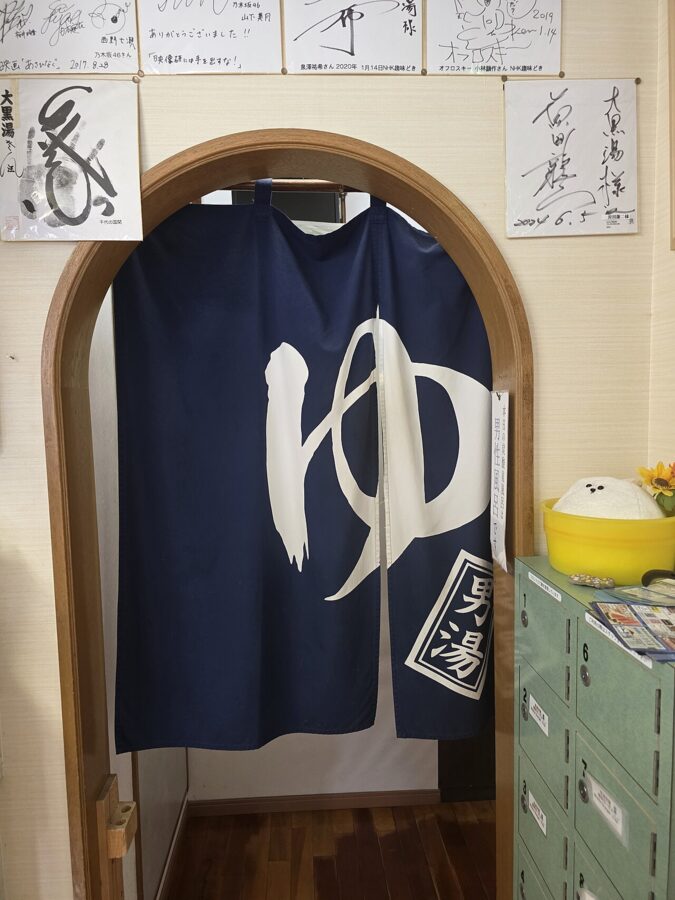
Check the curtain every time, even at a place you used yesterday. Ryokan often swap the two baths overnight so that each guest gets to try both.
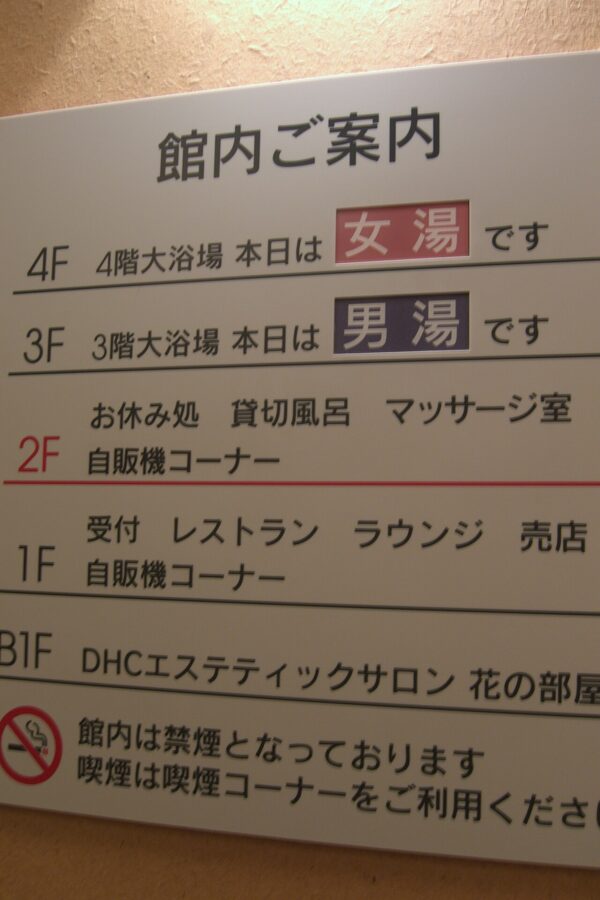

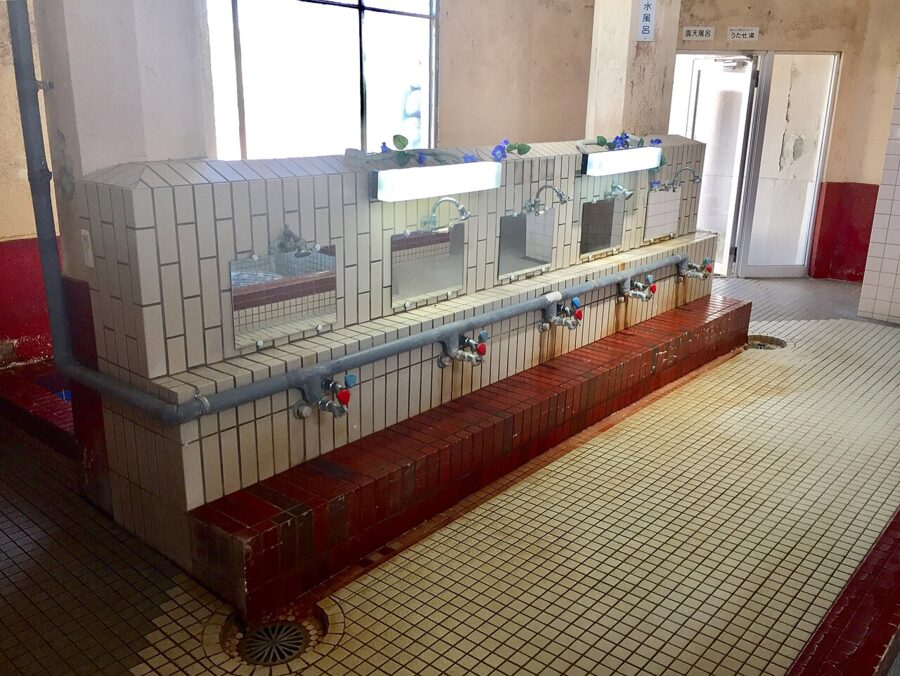
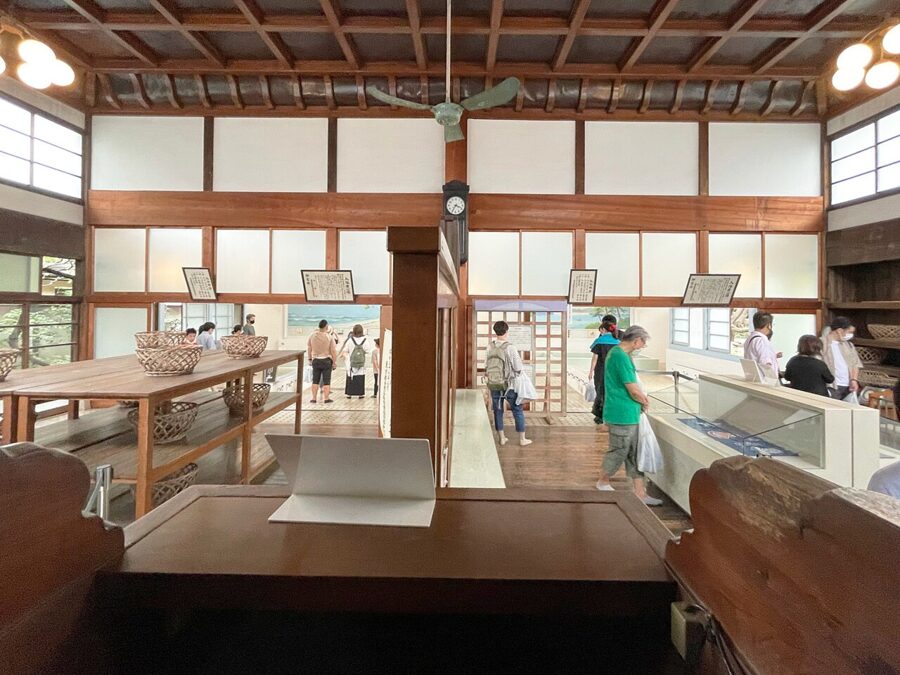
Inside, the layout barely varies. You leave your shoes in a locker at the door, pay at a counter or a ticket machine, then go through the curtain into the 脱衣所 (datsuijo, changing room), with baskets or lockers and usually a sink and hair dryers. A sliding door leads to the bathroom: the washing stations along one wall, the indoor bath or 内湯 (uchiyu) in the middle, and, if you’re lucky, a door out to the rotenburo.
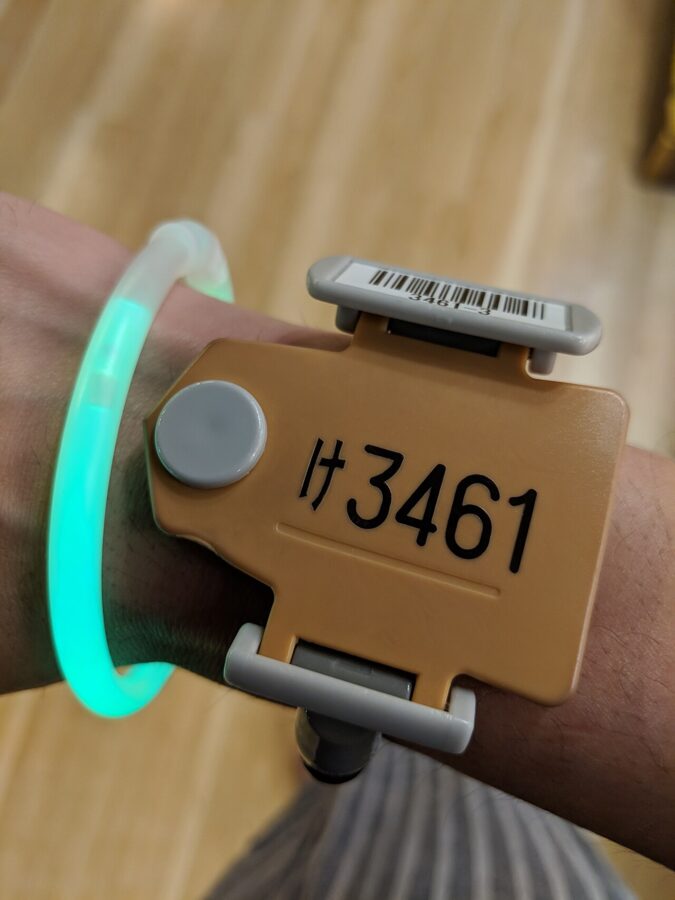

Some lockers take a coin that comes back when you open them again, so keep a few in your pocket (Japanese currency explains the coins). Old sento have a 番台 (bandai), a raised seat between the two changing rooms where the attendant takes the money and can see both sides. It looks odder than it is.
How to bathe, step by step
This is the whole routine, in order. One visit and you’ll stop thinking about it.
- Undress completely in the changing room. Take in only the small towel, plus soap and shampoo if the bath doesn’t supply them.
- Pour water over yourself at the bath’s edge or the washing station. This is 掛け湯 (kakeyu), and it starts with your feet and hands so your body gets used to the heat.
- Sit down and wash, everything, with soap. Rinse off every bit of foam, keep the shower pointed away from your neighbor, and rinse the stool when you’re done.
- Tie long hair up so it stays out of the water.
- Get in slowly and sit. The small towel stays out: fold it on your head or leave it on the edge.
- Keep it calm. No swimming, splashing or phones; quiet talk is fine.
- Wring out the towel and dry off before you walk back into the changing room, so you don’t drip on the floor others stand on.
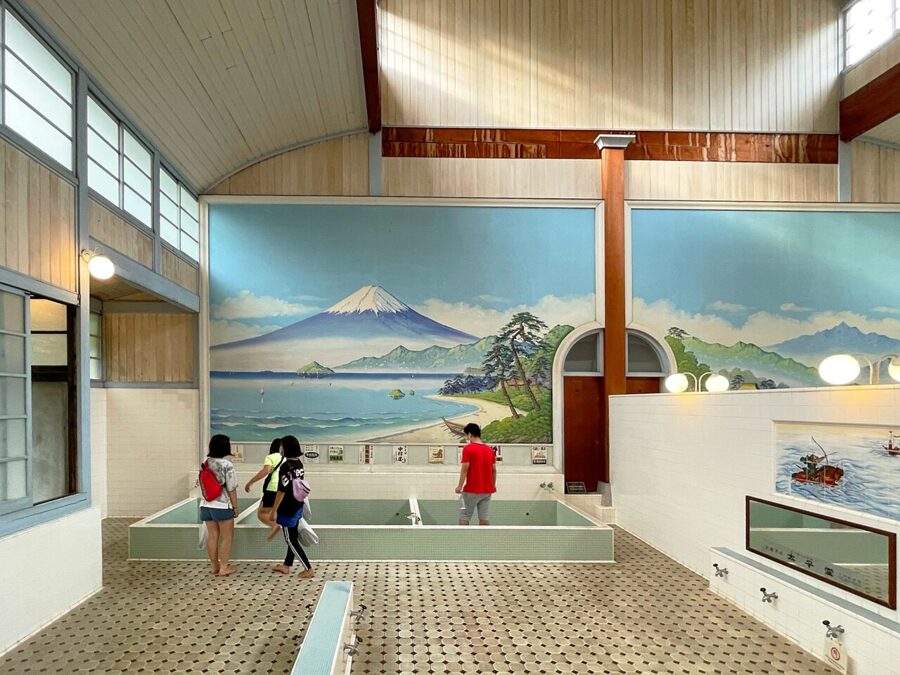
The towel rule is the one visitors break most often, usually by wrapping up before getting in. In the Ministry of the Environment’s own bathing notice, the line is plain: no towels in the tub, to keep the water clean. Holding the towel in front of you while you walk around is fine and very common.
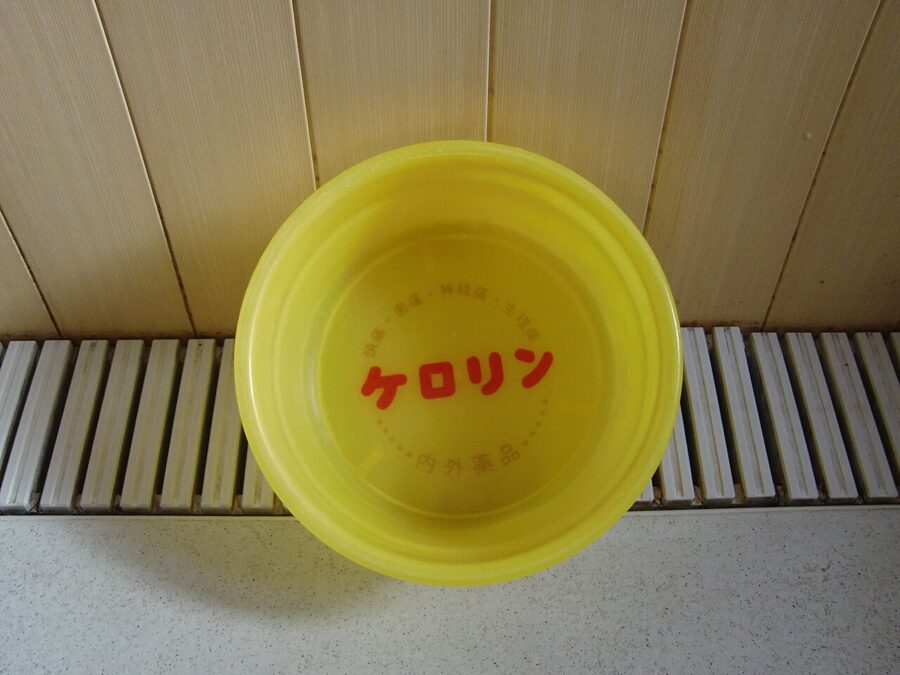

Should you shower again afterward? The same notice suggests not: leave the minerals on your skin and pat yourself dry, unless your skin is sensitive and the spring is acidic or sulfurous.
Outside, then back in
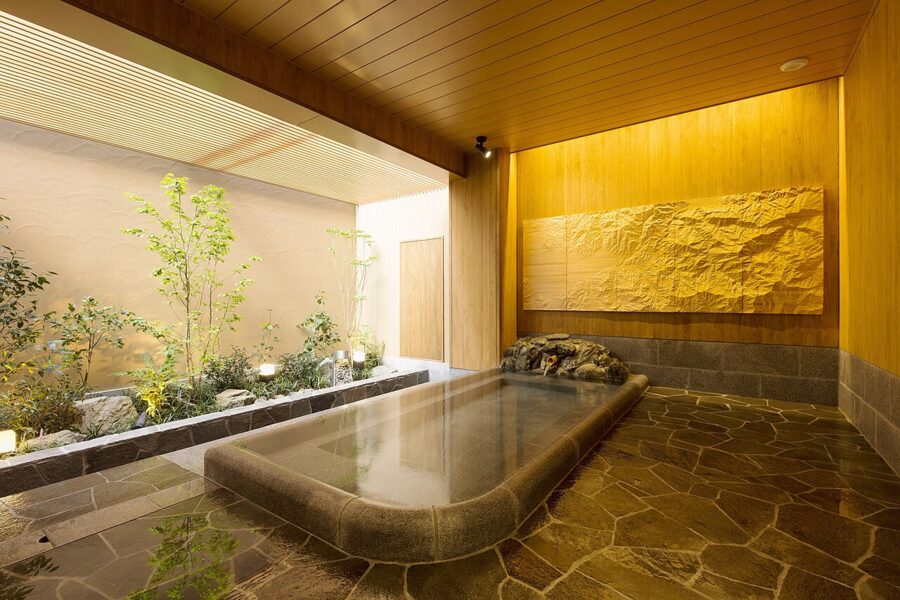
The rotenburo is usually through a door at the far end of the indoor bath, and the same rules hold out there. Most people go in and out several times, cooling off on a stone or a bench between soaks.

The rules that worry first-timers
Yes, completely naked
There’s no getting around it in a shared bath: no swimsuit, no shorts, no towel wrap. Nobody stares, because everyone is in the same state. If you can’t face it, book a private bath (below).
There is one recognized exception. People with scars from breast cancer surgery or skin grafts can ask about a purpose-made 入浴着 (nyūyokugi, bathing cover). Kinosaki’s town baths, for one, accept them as long as they are put on in the changing room and rinsed of soap before you get in.
Tattoos
This catches more foreign visitors than anything else, and the answer is: it depends on the place. Many onsen turn away anyone with a tattoo, a policy aimed at the yakuza, Japan’s organized crime groups, whose full-body work became the image of a tattoo here. In a 2015 Japan Tourism Agency survey, about 56 percent of the hotels and inns that answered said they refused tattooed guests in their baths, and another 13 percent allowed them only with the tattoo covered.
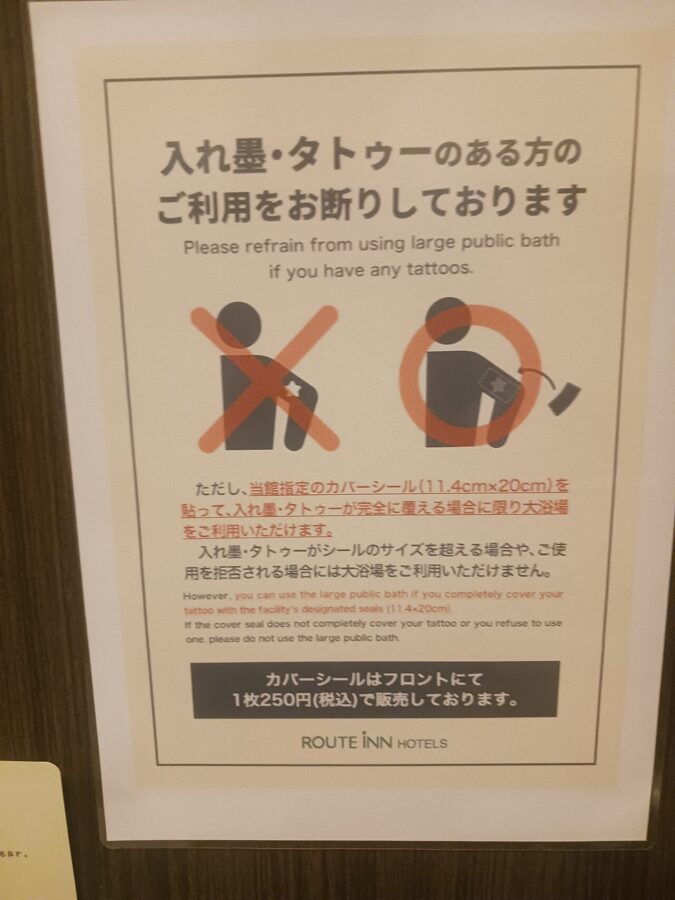
In March 2016 the agency asked bath operators to reconsider for foreign guests, noting that people wear tattoos for religious, cultural and fashion reasons. Its suggestions: let guests cover a small tattoo with a sticker, offer quieter time slots, or steer them to a private bath.
What works in practice:
- Check the bath’s own website for 入れ墨 or タトゥー in its rules.
- Cover a small one. Skin-colored cover patches sold for this (タトゥーシール, tatū shīru) are on sale at drugstores and discount shops, and a palm-sized tattoo under a patch is accepted in many places.
- Book a private bath, or a ryokan room with its own bath, and the question disappears.
- Try a neighborhood sento. They tend to be more relaxed than resort hotels, though each sets its own rule.
If a sign says no, it means no; the staff at the counter didn’t write the policy.
Mixed baths and private baths
混浴 (kon’yoku), mixed bathing, survives mostly in old mountain inns, and it is far rarer than the internet suggests. Many such baths now set women-only hours or allow a wrap. Couples who want to soak together are better served by a private bath.
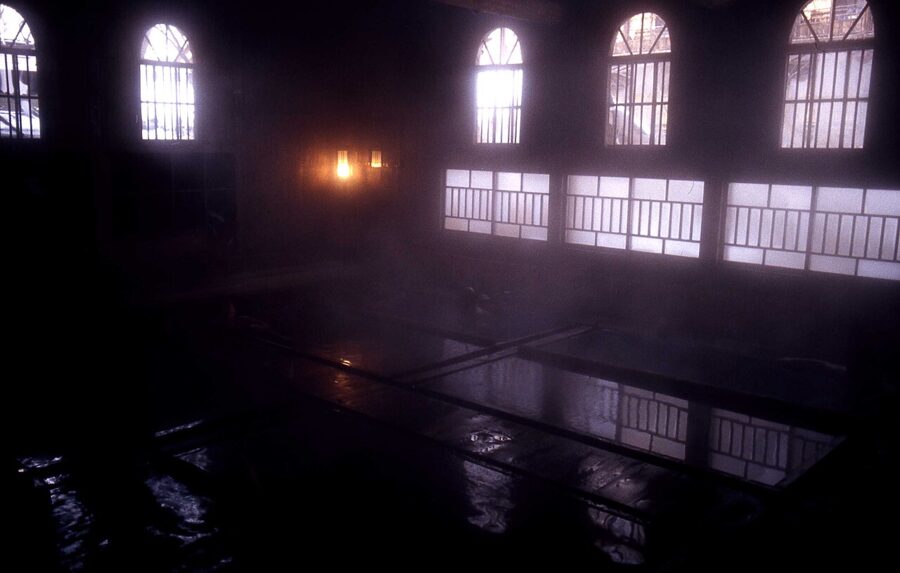
That private bath is the 貸切風呂 (kashikiri-buro, reserved bath), sometimes called 家族風呂 (kazoku-buro, family bath). You book a slot at the front desk, lock the door and have it to yourselves, partner, kids and tattoos included. Some ryokan include it in the room price; elsewhere it costs extra.

Children
Children are welcome, and Japanese families bathe together from infancy. The age limit for taking a child of the other sex into your side was lowered in December 2020, when the Ministry of Health revised its hygiene guidance for public baths from 10 to about 7. Prefectures adopted it on their own timetables (Hyogo’s rule took effect in April 2024), so a 6-year-old girl can still go in with her father, but an 8-year-old goes with her mother.
Babies still in diapers are usually not allowed in the shared tubs; a private bath solves that too.
Periods, pregnancy and health conditions
There is no national rule on bathing during a period. Many bath operators ask that you don’t use the shared tubs, and some say so in their rules. The usual answer is the same as for tattoos: an in-room bath or a reserved one, where the choice is yours.
Pregnancy is not a reason to stay out: the Ministry of the Environment’s guide says pregnant women can bathe, keeping soaks short and not too hot. Its list of reasons not to bathe at all is short: a fever, severe heart, lung or kidney disease, any bleeding, and a flare-up of a chronic illness.
Sulfur, iron, salt: the waters
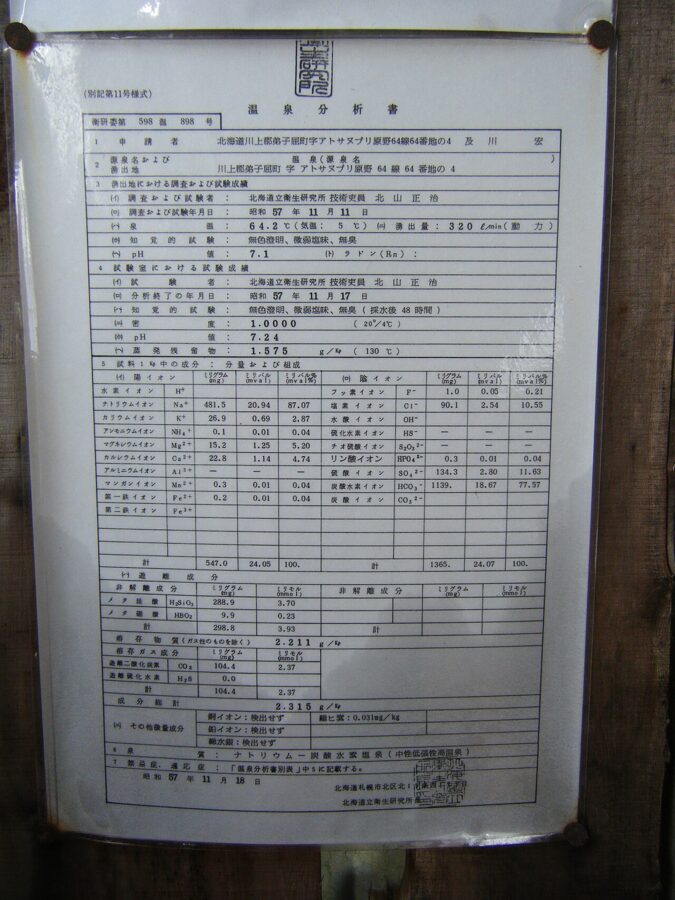
The analysis chart on the changing room wall names the water’s type. These are the ministry’s ten, with what you’ll notice in the bath.
| Type | Japanese | What you notice |
|---|---|---|
| Simple spring | 単純温泉 | Clear and gentle; under 1,000 mg of minerals per kg. Alkaline ones feel silky. |
| Chloride (salt) spring | 塩化物泉 | Salty taste; the salt film keeps you warm long after. Called the “onsen of heat”. |
| Hydrogen carbonate spring | 炭酸水素塩泉 | Slippery feel, sold as the “beauty onsen”. |
| Sulfate spring | 硫酸塩泉 | Often clear; a slightly bitter taste. |
| Carbon dioxide spring | 二酸化炭素泉 | Tiny bubbles cling to your skin; usually not very hot. |
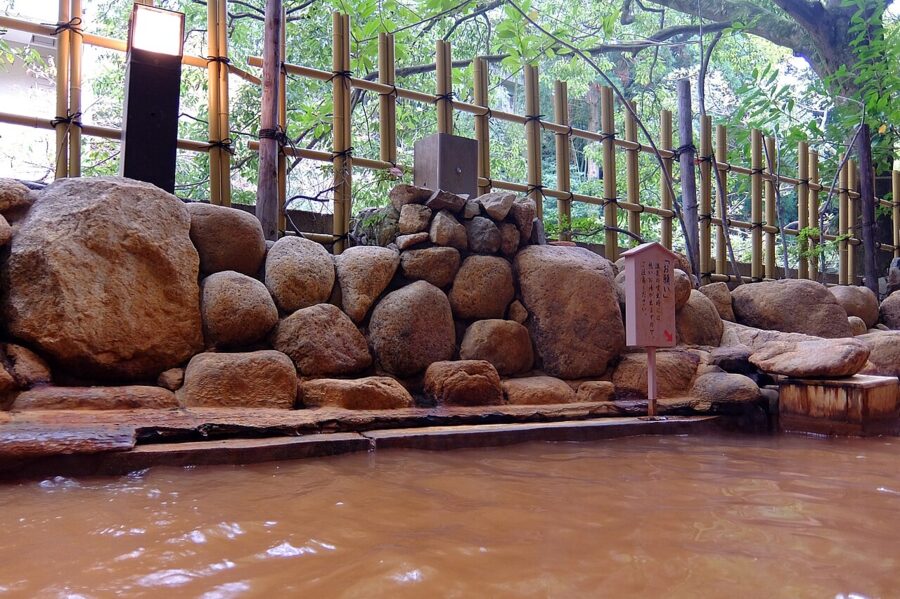
| Iron spring | 含鉄泉 | Clear at the source, then rusty brown as it meets the air. |
| Acidic spring | 酸性泉 | Stings small cuts; can taste sour. Rinse afterward if your skin is sensitive. |
| Iodine spring | 含よう素泉 | Turns yellowish when left standing. |
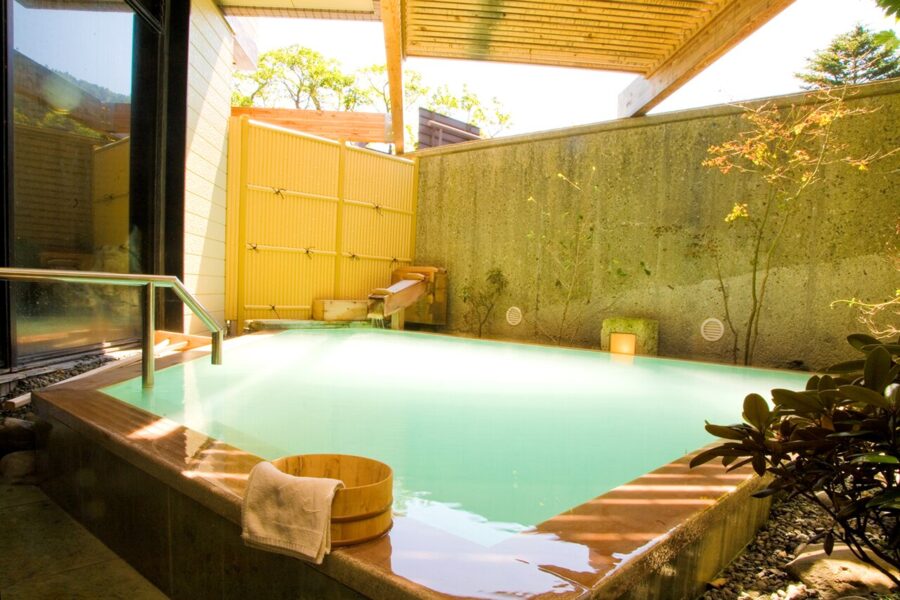
| Sulfur spring | 硫黄泉 | The rotten-egg smell, often milky white or blue. |
| Radioactive spring | 放射能泉 | Contains a little radon; looks like any other bath. |

Sulfur water tarnishes silver, so leave rings and chains in the locker. And the white flakes floating in a sulfur bath aren’t dirt: they are 湯の花 (yu-no-hana), “hot water flowers”, sold in packets in onsen towns as bath salts.

Take the healing claims on old signs lightly. The ministry’s own view is that a spring eases symptoms rather than curing anything, and that a real course takes two or three weeks. For a visitor the benefit is simpler: you sleep very well.
How long to stay in
Less time than you think. The ministry’s guidance is three to ten minutes a soak at first, building to 15 or 20 once you’re used to it, and only once or twice a day for the first few days. Older people and anyone with high blood pressure or a heart condition should skip baths of 42°C (108°F) or more.
Don’t bathe straight after a big meal or after drinking alcohol. Drink a glass of water before and after, and get out slowly, because standing up fast out of hot water makes people faint. If you feel dizzy, keep your head low, lie down and say のぼせ (nobose), the word for that light-headed feeling; the staff will know it.
For heat and other risks beyond the bath, see traveler safety in Japan.
Drinking the water
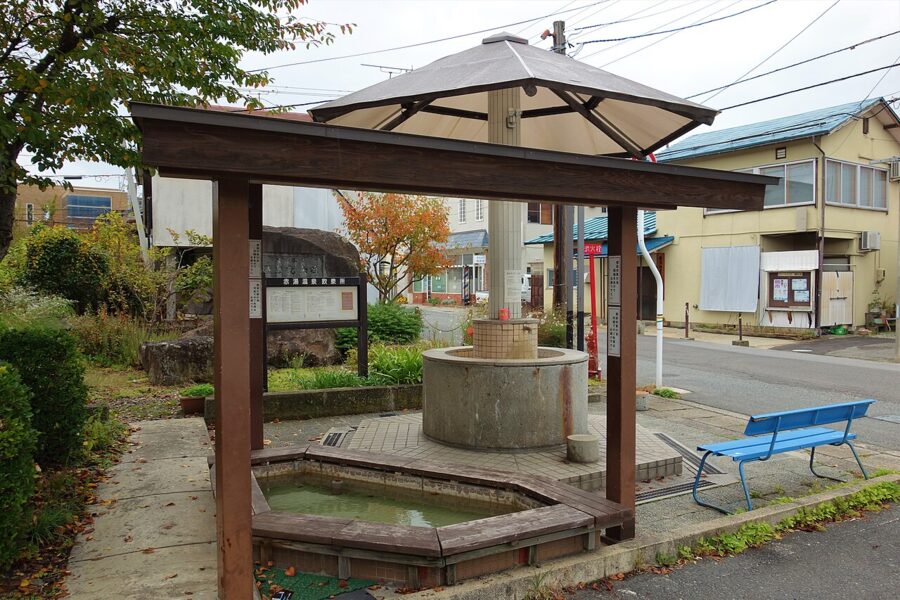
Some towns have a 飲泉所 (insenjo), a fountain where the spring is approved for drinking. Drink only where a sign says it is allowed, never from the bath itself. The ministry’s limits are 100 to 150 milliliters at a time and 200 to 500 a day, adults only, ideally half an hour before a meal, and you are not supposed to take it home.

Day bath, ryokan or sento?
A day bath, 日帰り入浴 (higaeri nyūyoku), is the easy start. Onsen towns have public bathhouses, and many hotels open their baths to non-guests in the afternoon. Pay at the door, rent a towel, and you’re in; check the weekly closing day before you travel.
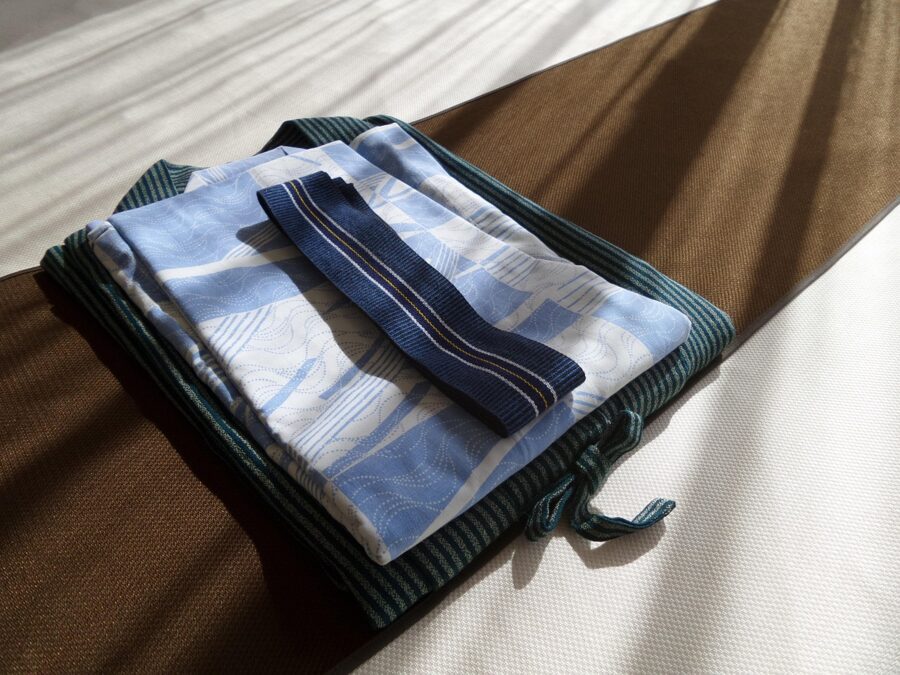
A ryokan, the traditional inn, is the full version: a large bath for each sex (大浴場, daiyokujō), often a private one, a cotton 浴衣 (yukata) robe for dinner and the streets, and a bath late at night and again at dawn. It costs more than a hotel, and it is the night most visitors remember. General travel information has more on fitting one into a trip.
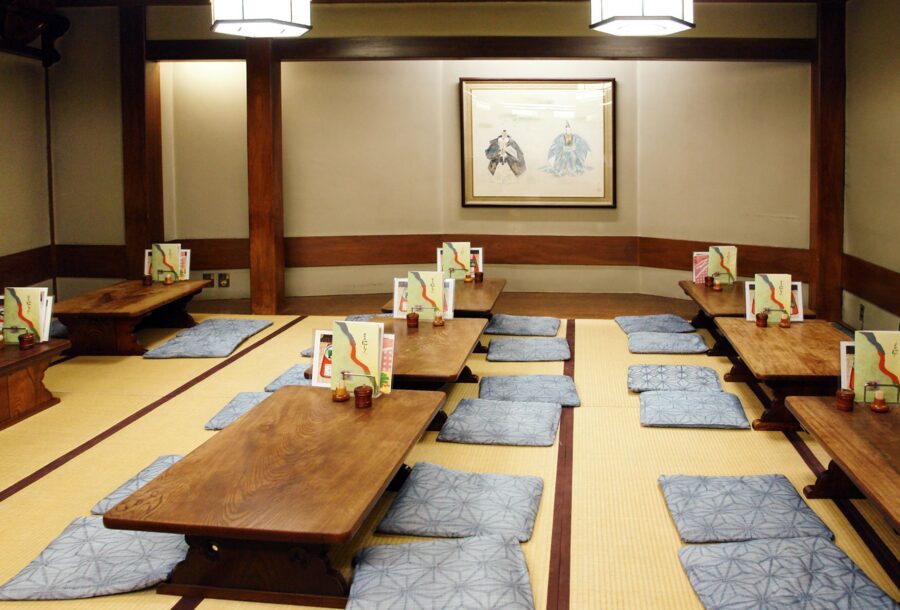
A sento is the everyday version and the best value. In Tokyo the adult price is capped by the Tokyo Metropolitan Government and, as of August 2026, is ¥600 (about US$4), with children under 12 at ¥200 and under-6s at ¥100. Bring a towel or buy one at the counter; soap and shampoo are sometimes free and sometimes sold.
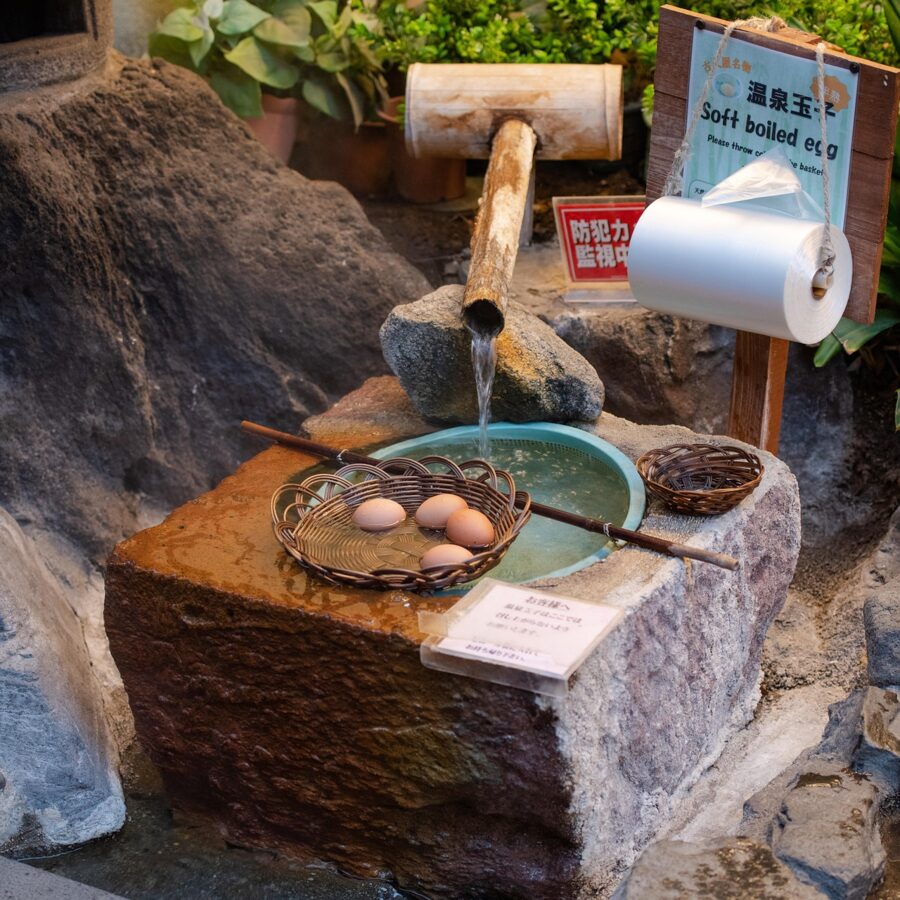
Which would I pick? One night in a ryokan in an onsen town, with a sento visit early in the trip to practice. Avoid Saturday nights and the holiday weeks if you can (the best times to visit Japan lists them); winter is the classic season.
Five towns that suit a first visit
These five are easy to reach, used to foreign visitors, and very different from one another. Longer write-ups of several are in Japanese vacation spots.
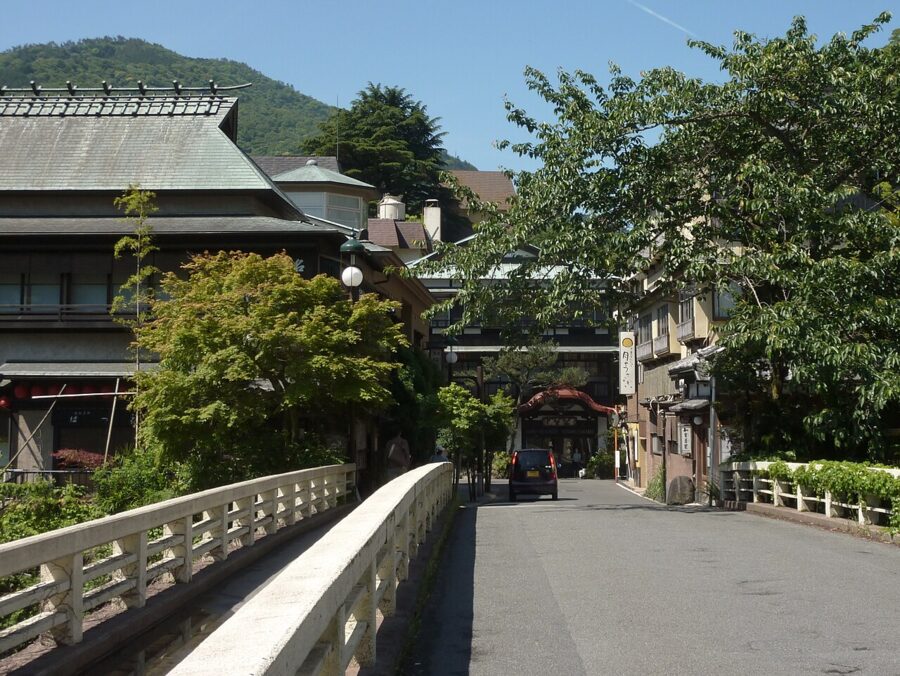
Hakone, in the mountains of Kanagawa, is the one most visitors from Tokyo reach first: Hakone-Yumoto is roughly an hour and a half from Shinjuku on the Odakyu line. Its baths run from cheap public halls to some of Japan’s most expensive ryokan, and its weekends are busy.

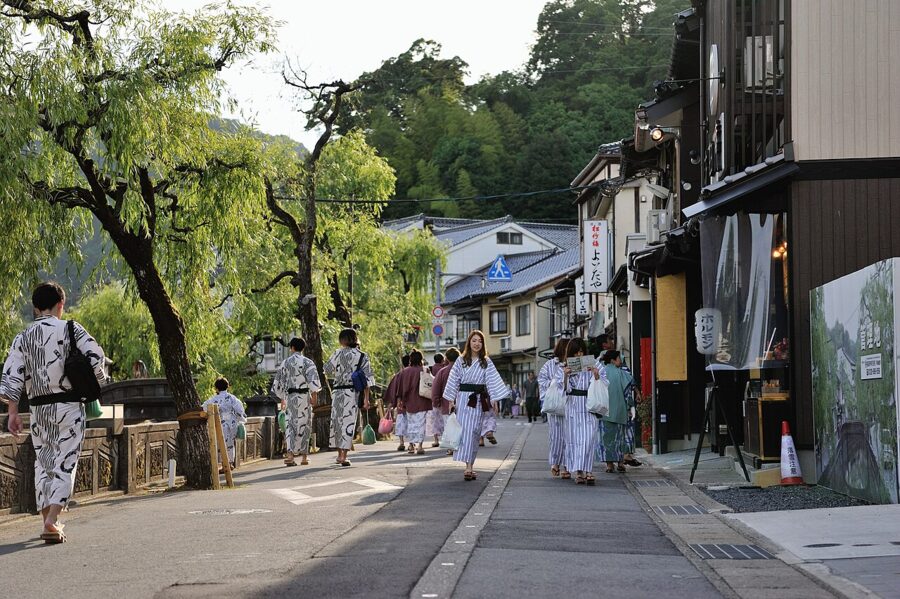
Kinosaki, on the Sea of Japan coast of Hyogo, is built for walking between baths. The town has seven public bathhouses, the 外湯 (sotoyu), and its inns give guests a pass that opens them, so people stroll the willow-lined canal in yukata from one to the next. One of them, Satonoyu by the station, has been closed since March 2024. Kinosaki is about two and a half hours from Kyoto or Osaka by limited express.

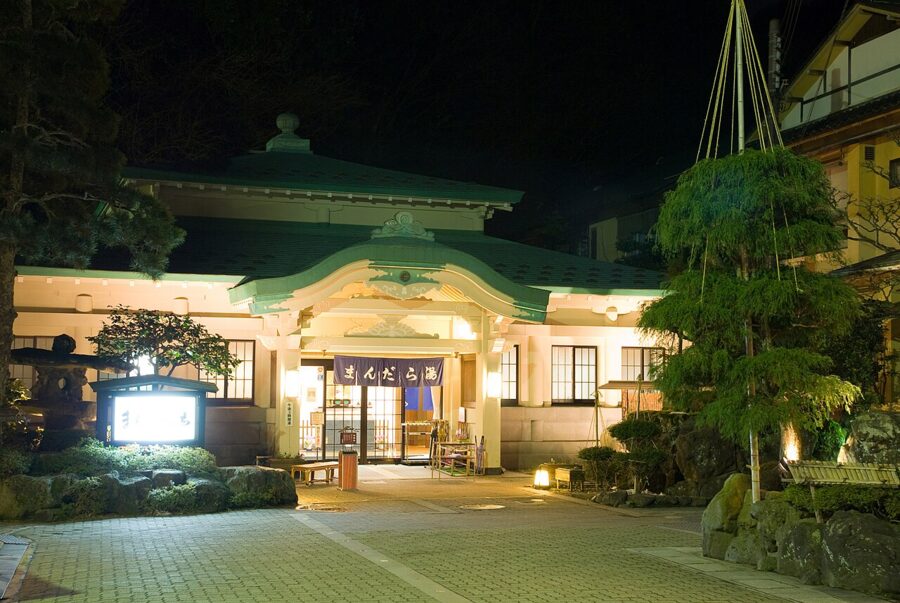

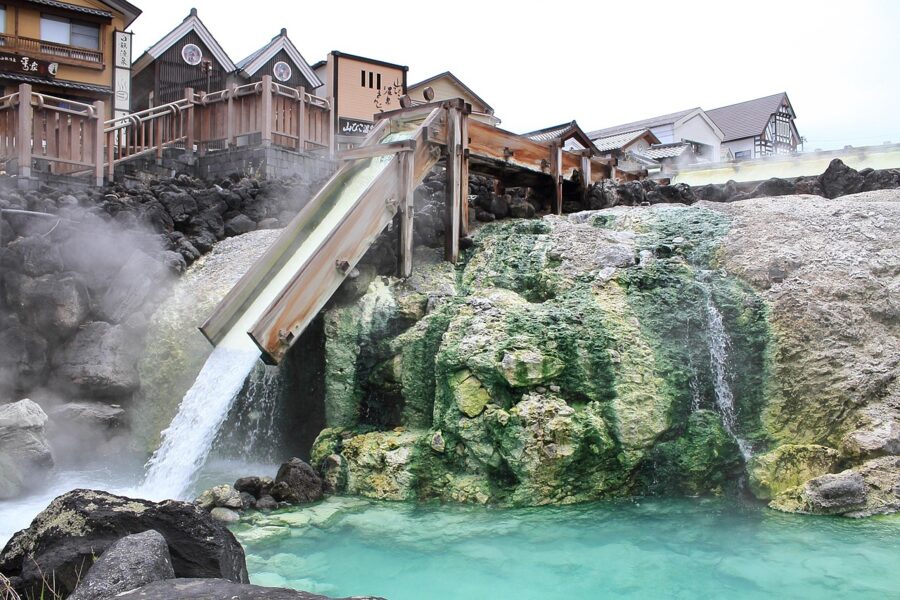
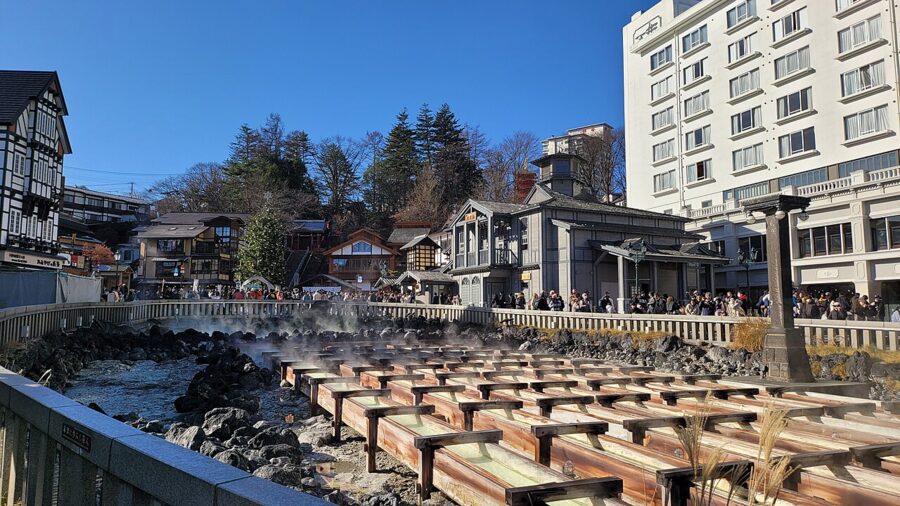
Kusatsu, high in the mountains of Gunma, has the largest natural flow in Japan: more than 32,300 liters a minute, according to the town. The water is strongly acidic, around pH 2.1 at the main source, so it stings any scratch. From Tokyo it is a limited express to Naganohara-Kusatsuguchi and a bus up the hill, or a direct highway bus.
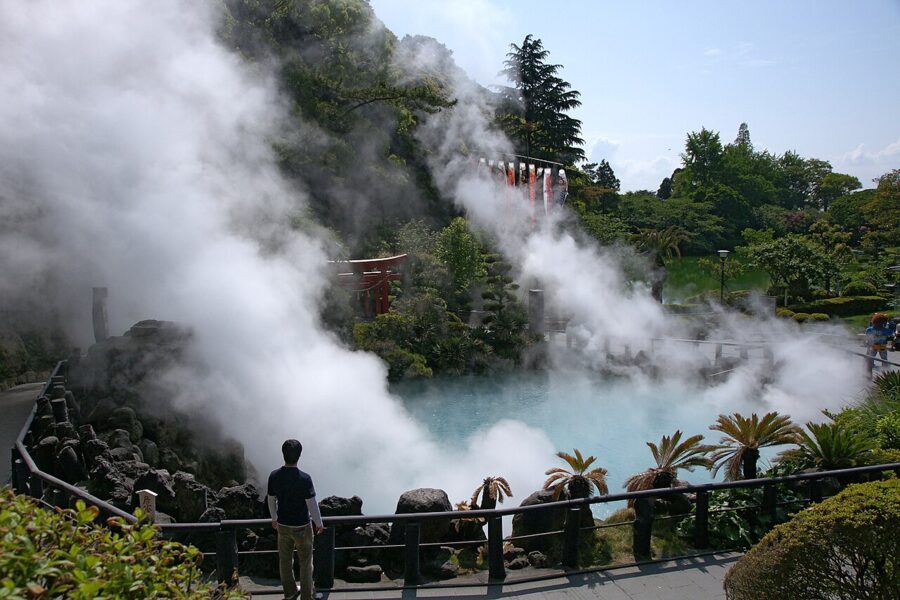
Beppu, on Kyushu’s east coast, sits in Oita, the prefecture with more hot spring sources than any other: 5,094 in the ministry’s latest count. Its famous 地獄 (jigoku, hells) are boiling pools to look at; the bathing happens in dozens of cheap public baths across town. Beppu is about two hours from Hakata by limited express.

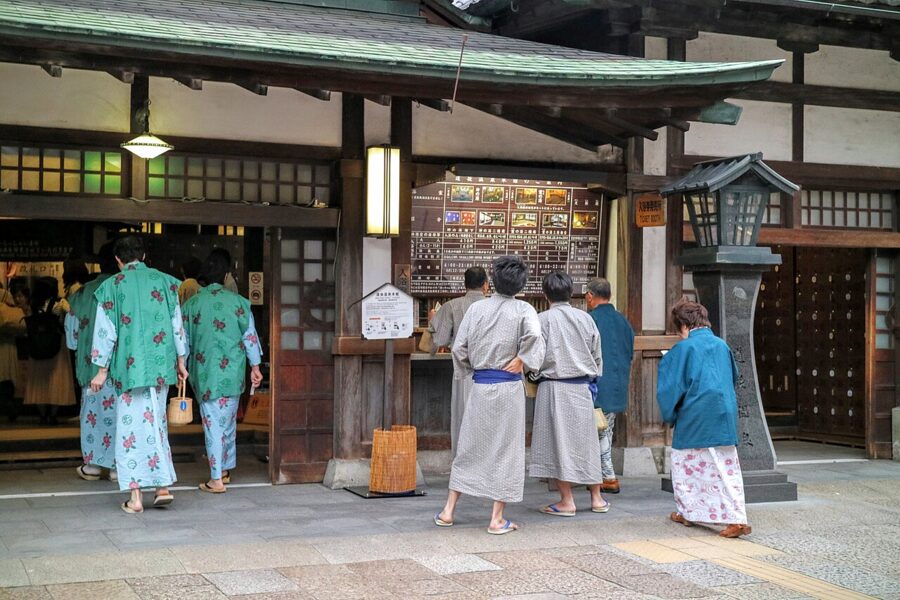
Dogo, in Matsuyama on Shikoku, claims some 3,000 years of history. Its wooden main building, Dogo Onsen Honkan, was the first public bath named an Important Cultural Property, in 1994, and reopened fully in 2024 after six years of repairs carried out while it stayed partly open. As of November 2026 a bath in its main hall, Kami-no-yu, costs ¥700 (about US$5), and the building opens at 6 a.m. Trams from JR Matsuyama Station run to Dogo Onsen stop.

Wherever you go, the first minute is the same. Find the ゆ, check the curtain, undress, and sit down at a tap before you go anywhere near the water. Everything else you can pick up by watching the person next to you.